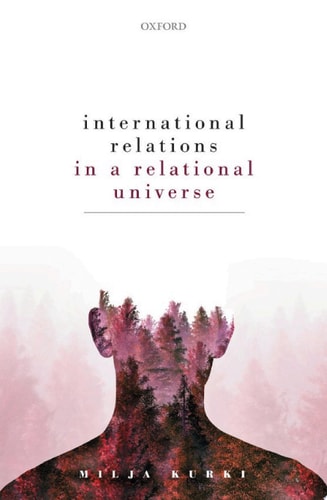
International Relations in a Relational Universe
0
0
As an Amazon Associate and affiliate partner, Menrva Books earns from qualifying purchases. Learn more
Author Description
It is time for International Relations (IR) to join the relational revolution afoot in the natural and social sciences. To do so, more careful reflection is needed on cosmological assumptions in the sciences and also in the study and practice of international relations. In particular it is argued here that we need to pay careful attention to whether and how we think 'relationally'. Building a conversation between relational cosmology, developed in natural sciences, and critical social theory, this book seeks to develop a new perspective on how to think relationally in and around the study of IR. International Relations in a Relational Universe asks: What kind of cosmological background assumptions do we make as we tackle international relations today and where do our assumptions (about states, individuals, or the international) come from? And can we reorient our cosmological imaginations towards more relational understanding of the universe and what would this mean for the study and practice of international politics? The book argues that we live in a world without 'things', a world of processes and relations. It also suggests that we live in relations which exceed the boundaries of the human and the social, in planetary relations with plants and animals. Rethinking conceptual premises of IR, Kurki points towards a 'planetary politics' perspective within which we can reimagine IR as a field of study and also political practices, including the future of democracy.
Menrva's Summary
THE THESIS
This book investigates the cosmological assumptions underpinning the study and practice of international relations by advocating for a shift toward a relational understanding of the universe. Milja Kurki, a scholar in international relations and social theory, draws upon relational cosmology from the natural sciences and critical social theory to challenge the conventional focus on discrete entities. The author argues that the field must move beyond the study of static 'things' to embrace a process-oriented perspective that accounts for the interconnectedness of human, social, and planetary systems.
THE SCOPE MAP
What You Will Find
- A synthesis of relational cosmology and critical social theory.
- A critique of traditional ontological assumptions regarding states and individuals.
- A conceptual framework for 'planetary politics' that includes non-human actors.
Scope Limits
- The text does not provide a practical policy manual for immediate diplomatic application.
- It does not offer a comprehensive history of all international relations theories.
THE AUTHORITY PERSPECTIVE
Scholars in the field recognize this work as a significant contribution to the ontological turn within international relations theory. Readers frequently note the academic density of the prose, which requires a strong background in social theory to fully grasp the proposed cosmological shifts.
Page Count:
226
Publication Date:
2020-01-01
Publisher:
OUP Oxford
ISBN-10:
0192591460
ISBN-13:
9780192591463
International relations
Philosophy of
Cosmology
Planetary Politics
Relationism
Social Theory