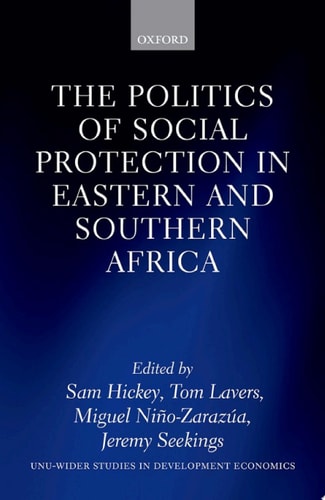
The Politics of Social Protection in Eastern and Southern Africa
0
0
As an Amazon Associate and affiliate partner, Menrva Books earns from qualifying purchases. Learn more
Author Description
The notion that social protection should be a key strategy for reducing poverty in developing countries has now been mainstreamed within international development policy and practice. Promoted as an integral dimension of the post-Washington Consensus all major international development agencies and bilateral donors now include a strong focus on social protection in their advocacy and programmatic interventions and a commitment to providing social protection was recently enshrined within the Sustainable Development Goals. The rhetoric around social protection, particularly when delivered in the form of cash transfers, has sometimes reached hyperbolic proportions with advocates seeing it as a magic bullet that can tackle multi-dimensional problems of poverty, vulnerability, and inequality and a southern-led success story that challenges the unequal power relations inherent within international aid. The Politics of Social Protection in Eastern and Southern Africa challenges the common conception that this phenomenon has been entirely driven by international development agencies, instead focusing on the critical role of political dynamics within specific African countries. It details how the power and politics at multiple levels of governance shapes the extent to which political elites are committed to social protection, the form that this commitment takes, and the implications that this has for future welfare regimes and state-citizen relations in Africa. It reveals how international pressures only take hold when they become aligned with the incentives and ideas of ruling elites in particular contexts. It shows how elections, the politics of clientelism, political ideologies, and elite perceptions all play powerful roles in shaping when countries adopt social protection and at what levels, which groups receive benefits, and how programmes are delivered.
Menrva's Summary
THE THESIS
This book investigates how domestic political dynamics, rather than solely international influence, shape the adoption and implementation of social protection programs in Eastern and Southern Africa. The authors, Dr. Tom Lavers, Sam Hickey, and Miguel Niño-Zarazúa, leverage extensive comparative research to argue that international development agendas only succeed when they align with the specific incentives, ideologies, and power structures of national ruling elites. By examining the intersection of elections, clientelism, and state-citizen relations, the text provides a framework for understanding why social protection policies vary significantly across different African contexts.
THE SCOPE MAP
What You Will Find
- Comparative analysis of social protection policy adoption across multiple Eastern and Southern African nations.
- Examination of the influence of political elites, electoral cycles, and ideological shifts on welfare outcomes.
- Analysis of the interaction between international donor pressures and domestic political incentives.
Scope Limits
- The study focuses primarily on Eastern and Southern Africa and does not provide a comprehensive analysis of social protection policies in West or North Africa.
- The text does not offer a technical manual for the implementation of cash transfer programs, focusing instead on the political economy of their adoption.
THE AUTHORITY PERSPECTIVE
Experts in development economics and African politics recognize this work as a significant contribution to the political economy of welfare regimes. Readers frequently note the academic rigor and the depth of the comparative analysis, making it a valuable resource for scholars and policy practitioners interested in the intersection of governance and poverty reduction.
Page Count:
308
Publication Date:
2019-01-01
Publisher:
OUP Oxford
ISBN-10:
0192590693
ISBN-13:
9780192590695
Economics
Public Policy
Social Welfare
Community Tags
Similar Books