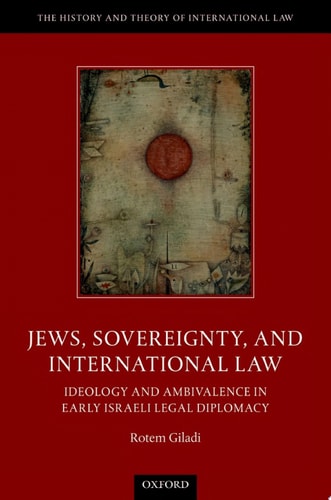
Jews, Sovereignty, and International Law: Ideology and Ambivalence in Early Israeli Legal Diplomacy
0
0
As an Amazon Associate and affiliate partner, Menrva Books earns from qualifying purchases. Learn more
Author Description
By departing from accounts of a universalist component in Israel's early foreign policy, Rotem Giladi challenges prevalent assumptions on the cosmopolitan outlook of Jewish international law scholars and practitioners, offers new vantage points on modern Jewish history, and critiques orthodox interpretations of the Jewish aspect of Israel's foreign policy. Drawing on archival sources, the book reveals the patent ambivalence of two jurist-diplomats-Jacob Robinson and Shabtai Rosenne-towards three international law reform projects: the right of petition in the draft Human Rights Covenant, the 1948 Genocide Convention, and the 1951 Refugee Convention. In all cases, Rosenne and Robinson approached international law with disinterest, aversion, and hostility while, nonetheless, investing much time and toil in these post-war reforms. The book demonstrates that, rather than the Middle East conflict, Rosenne and Robinson's ambivalence towards international law was driven by ideological sensibilities predating Israel's establishment. In so doing, Jews, Sovereignty, and International Law disaggregates and reframes the perspectives offered by the growing scholarship on Jewish international lawyers, providing new insights concerning the origins of human rights, the remaking of postwar international law, and the early years of the UN.
Menrva's Summary
THE THESIS
This book investigates the ideological motivations and inherent ambivalence of early Israeli jurist-diplomats toward the development of post-war international law. Rotem Giladi, a scholar of international law and history, utilizes extensive archival research to challenge the traditional narrative that early Israeli foreign policy was defined by a universalist or cosmopolitan outlook. By focusing on the specific contributions and private reservations of Jacob Robinson and Shabtai Rosenne, the author argues that their engagement with international legal frameworks was shaped by pre-existing ideological sensibilities rather than the immediate pressures of the Middle East conflict.
THE SCOPE MAP
What You Will Find
- Analysis of the 1948 Genocide Convention and the 1951 Refugee Convention.
- Examination of the right of petition within the draft Human Rights Covenant.
- Archival evidence detailing the professional correspondence and internal deliberations of Jacob Robinson and Shabtai Rosenne.
Scope Limits
- The study does not provide a comprehensive history of all Israeli diplomatic efforts during the early UN years.
- It does not focus on the broader geopolitical military conflicts of the era, prioritizing ideological and legal history instead.
THE AUTHORITY PERSPECTIVE
Scholars in the field of international legal history recognize this work as a significant contribution to understanding the nuanced role of Jewish jurists in the post-war era. Readers frequently note the academic density of the prose and the author's meticulous use of primary source documentation to reframe established historical narratives.
Page Count:
354
Publication Date:
2021-01-01
Publisher:
OUP Oxford
ISBN-10:
0192599291
ISBN-13:
9780192599292
History
Professional Career & Trade
International Law
Jewish Studies
Diplomatic History
Human rights