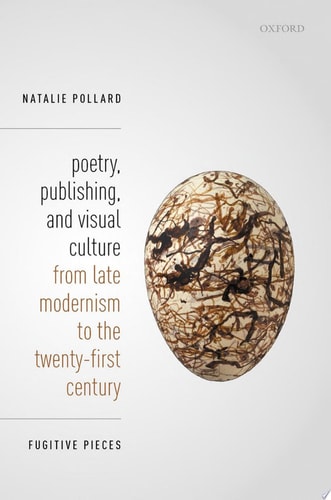
Poetry, Publishing, and Visual Culture from Late Modernism to the Twenty-first Century
0
0
As an Amazon Associate and affiliate partner, Menrva Books earns from qualifying purchases. Learn more
Author Description
This is a book about contemporary literary and artistic entanglements: word and image, media and materiality, inscription and illustration. It proposes a vulnerable, fugitive mode of reading poetry, which defies disciplinary categorisations, embracing the open-endedness and provisionality of forms. This manifests itself interactively in the six case studies, which have been chosen for their distinctness and diversity across the long twentieth century: the book begins with the early twentieth-century work of writer and artist Djuna Barnes, exploring her re-animation of sculptural and dramatic sources. It then turns to the late modernist artist and poet David Jones considering his use of the graphic and plastic arts in The Anathemata, and next, to the underappreciated mid-century poet F.T. Prince, whose work uncannily re-activates Michelangelo's poetry and sculpture. The second half of the book explores the collaborations of the canonical poet Ted Hughes with the publisher and artist Leonard Baskin during the 1970s; the innovative late twentieth-century poetry of Denise Riley who uses page space and embodied sound as a form of address; and, finally, the contemporary poet Paul Muldoon who has collaborated with photographers and artists, as well as ventriloquising nonhuman phenomena. The resulting unique study offers contemporary writers and readers a new understanding of literary, artistic, and nonhuman practices and shows the cultural importance of engaging with their messy co-dependencies. The book challenges critical methodologies that make a sharp division between the textual work and the extra-literary, and raises urgent questions about the status and autonomy of art and its social role.
Menrva's Summary
THE THESIS
This book investigates the complex intersections between poetry, visual art, and material culture from the early twentieth century to the present day. Natalie Pollard, a scholar of modern and contemporary literature, argues that traditional critical boundaries between textual and extra-literary works obscure the essential co-dependencies of these mediums. By examining specific creative collaborations and individual practices, the author proposes a methodology of reading that embraces the provisional and open-ended nature of artistic forms.
THE SCOPE MAP
What You Will Find
- Analysis of six distinct case studies including Djuna Barnes, David Jones, F.T. Prince, Ted Hughes, Denise Riley, and Paul Muldoon.
- Examination of word-image relationships, media materiality, and the role of inscription and illustration.
- Exploration of how poetry interacts with sculpture, photography, and nonhuman phenomena.
Scope Limits
- The study does not provide an exhaustive history of all twentieth-century poetry or visual art.
- It focuses specifically on selected case studies rather than offering a comprehensive survey of every movement within the period.
THE AUTHORITY PERSPECTIVE
Scholars and critics recognize this work as a significant contribution to the field of interdisciplinary literary studies. Readers frequently note the academic density of the prose, which challenges established methodologies regarding the autonomy of art.
Page Count:
304
Publication Date:
2020-01-01
Publisher:
Oxford University Press
ISBN-10:
019259396X
ISBN-13:
9780192593962
Modernism
Art History
Poetry Studies
Visual Culture
Literary Criticism
Community Tags
Similar Books