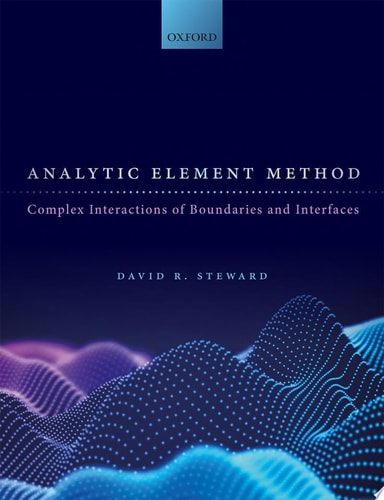
Analytic Element Method
0
0
As an Amazon Associate and affiliate partner, Menrva Books earns from qualifying purchases. Learn more
Author Description
"Analytic Element Method" (AEM) assembles a broad range of mathematical and computational approaches to solve important problems in engineering and science. As the subtitle "Complex Interactions of Boundaries and Interfaces" suggests, problems are partitioned into sets of elements and methods are formulated to solve conditions along their boundaries and interfaces. Presentation will place an element within its landscape, formulate its interactions with other elements using linear series of influence functions, and then solve for its coefficients to match its boundary and interface conditions. Computational methods enable boundary and interface conditions of closely interacting elements to be matched with nearly exact precision, commonly to within 8-12 significant digits. Comprehensive solutions provide elements that collectively interact and shape the environment within which they exist. This work is grounded in a wide range of foundational studies, using exact solutions for important boundary value problems. However, the computational capacity of their times limited solutions to idealized problems, commonly involving a single isolated element within a uniform regional background. With the advent of modern computers, such mathematically based methods were passed over by many, in the pursuit of discretized domain solutions using finite element and finite difference methods. Yet, the elegance of the mathematical foundational studies remains, and the rationale for the Analytic Element Method was inspired by the realization that computational advances could also lead to advances in the mathematical methods that were unforeseeable in the past.
Menrva's Summary
THE THESIS
This text investigates the application of the Analytic Element Method (AEM) as a robust mathematical and computational framework for solving complex boundary value problems in engineering and science. Author David R. Steward, an expert in the field, synthesizes foundational mathematical studies with modern computational capabilities to address the limitations of traditional discretized domain methods. The work argues that AEM provides a superior, high-precision alternative for modeling interacting elements within a landscape by utilizing influence functions to match boundary and interface conditions.
THE SCOPE MAP
What You Will Find
- Mathematical formulation of influence functions for element interaction
- Computational techniques for solving boundary and interface conditions with high precision
- Integration of foundational boundary value studies with modern computing power
Scope Limits
- The text focuses on the specific methodology of AEM rather than broad comparisons with all existing numerical modeling software
- It assumes a baseline understanding of engineering mathematics and boundary value problems
THE AUTHORITY PERSPECTIVE
Experts recognize this work as a significant contribution to the revival and modernization of analytic methods in computational engineering. Readers frequently note the technical density of the prose, which serves as a rigorous resource for researchers and practitioners seeking high-precision modeling solutions.
Page Count:
466
Publication Date:
2020-01-01
Publisher:
Oxford University Press Academic UK
ISBN-10:
019259883X
ISBN-13:
9780192598837
Mathematics
Fluid dynamics
Numerical analysis
Engineering
Community Tags
Other Editions(2)
Similar Books