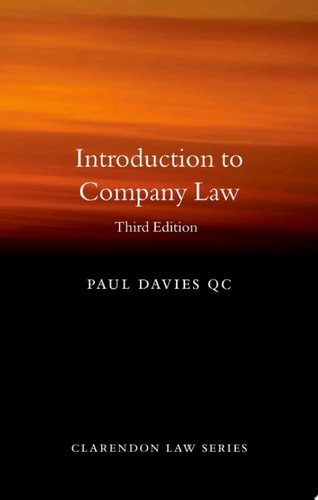
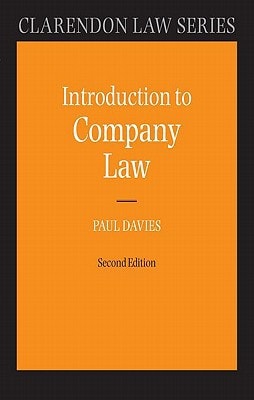
Introduction to Company Law
0
0
As an Amazon Associate and affiliate partner, Menrva Books earns from qualifying purchases. Learn more
Author Description
Since the financial crisis of 2007 to 2009 the role of the company in society, especially the role of publicly traded companies, has acquired a political salience that was largely absent in the decades before the crisis. This concern has been reflected in both enhanced reporting requirements and in the latest version of the Corporate Governance and Stewardship Codes applicable to the largest companies. This books analyses these developments in full, as well as the more fundamental proposals for reform of corporate law that have been advanced outside official circles. The book also examines the functions of the five core features of company law-separate legal personality, limited liability, centralized management, shareholder control, and transferability of shares. It finally analyses the legal strategies available for moderating the frictions that these core features nevertheless generate for those providing the necessary inputs for a company's business. Written by one of the field's foremost experts, Paul Davies' Introduction to Company Law provides a comprehensive conceptual introduction to the subject, giving readers a clear framework with which to navigate the intricacies of company law.
Menrva's Summary
THE THESIS
This text investigates the core functions of company law and how they have evolved in response to the political and economic pressures following the 2007-2009 financial crisis. Paul Davies, a prominent legal scholar, utilizes a conceptual framework to analyze the intersection of corporate governance, reporting requirements, and the fundamental legal structures that define modern business entities. The book argues that while core features like limited liability and centralized management are essential, they generate inherent frictions that require specific legal strategies to manage effectively.
THE SCOPE MAP
What You Will Find
- Analysis of the five core features of company law: separate legal personality, limited liability, centralized management, shareholder control, and transferability of shares.
- Examination of post-crisis corporate governance and stewardship codes.
- Evaluation of reform proposals for corporate law originating outside official regulatory bodies.
Scope Limits
- The text focuses primarily on the legal framework of publicly traded companies rather than small private enterprises.
- It does not provide a practical handbook for corporate litigation or day-to-day business management.
THE AUTHORITY PERSPECTIVE
Legal scholars and students frequently identify this work as a foundational text for understanding the conceptual underpinnings of corporate law. Experts highlight the clarity of the prose, noting that it successfully navigates complex regulatory developments while maintaining a focus on core legal principles.
Page Count:
387
Publication Date:
2020-01-01
Publisher:
OUP Oxford
ISBN-10:
0192597159
ISBN-13:
9780192597151
Law
Professional Career & Trade
Business Law
Corporate Law
Reference
Academic
Great Britain
Community Tags
Other Editions(4)
Similar Books