Integrated Marketing Communications: A focus on new technologies and advanced theories
0
0
As an Amazon Associate and affiliate partner, Menrva Books earns from qualifying purchases. Learn more
Author Description
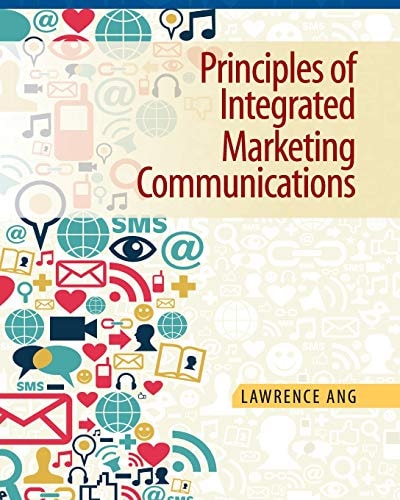
Principles of Integrated Marketing Communications explains the principles and practice of implementing effective IMC using a variety of channels and techniques. It equips readers with the knowledge to develop sophisticated marketing campaigns for contemporary business environments. Designed to introduce readers to IMC in an engaging way, this valuable resource: • Covers the latest concepts and tools in marketing and communications • Presents topics in light of their underlying theories and principles • Includes case studies adapted from recent, real-world examples (drawn from both Australian and international contexts). Each chapter contains a 'Further thinking' section, giving readers the opportunity to extend their understanding of the conceptual and historical underpinnings of IMC, and teaching them how to analyse and overcome problems when devising an IMC strategy. Each chapter also includes learning objectives and review questions, to reinforce knowledge. Additional material - including extra case studies and topical multimedia files - is available on the companion website at www.cambridge.edu.au/academic/imc.
Menrva's Summary
THE THESIS
This book investigates the principles and practice of implementing effective Integrated Marketing Communications (IMC) in contemporary business environments. Lawrence Ang's work equips readers with the knowledge to develop sophisticated marketing campaigns by covering the latest concepts and tools in marketing and communications. It presents topics in light of their underlying theories and principles, utilizing case studies adapted from recent, real-world examples from both Australian and international contexts. Each chapter is designed to reinforce knowledge through learning objectives, review questions, and a 'Further thinking' section to encourage analysis and problem-solving in IMC strategy.
THE SCOPE MAP
- Covers the latest concepts and tools in marketing and communications.
- Presents topics in light of their underlying theories and principles.
- Includes case studies adapted from recent, real-world examples (Australian and international).
- Features a 'Further thinking' section in each chapter for extended understanding and problem analysis.
- Provides learning objectives and review questions to reinforce knowledge.
- Offers additional material, including extra case studies and topical multimedia files, on a companion website.
THE AUTHORITY PERSPECTIVE
The book is structured to provide a comprehensive understanding of Integrated Marketing Communications, focusing on contemporary applications and theoretical underpinnings. Its approach integrates recent case studies and practical exercises, suggesting it aims to be a valuable resource for students and professionals alike. The inclusion of a companion website with supplementary materials indicates a commitment to providing up-to-date and extensive learning opportunities. The pedagogical features, such as learning objectives and review questions, point to a design intended for effective knowledge acquisition and retention.
Page Count:
400
Publication Date:
2014-01-02
Publisher:
Cambridge University Press
ISBN-10:
1107649188
ISBN-13:
9781107649187
Non-Fiction
Business
Marketing
Communications
Community Tags
Similar Books