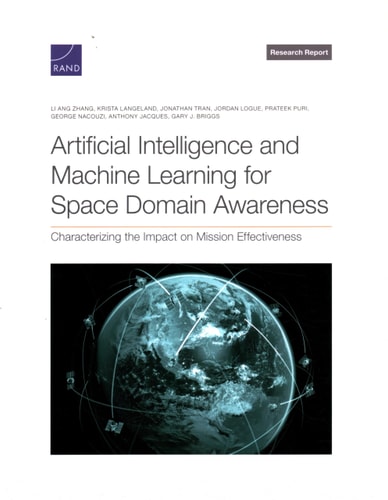
Artificial Intelligence and Machine Learning for Space Domain Awareness: Characterizing the Impact on Mission Effectiveness
0
0
As an Amazon Associate and affiliate partner, Menrva Books earns from qualifying purchases. Learn more
Author Description
To address the growing demands of operating in the space domain, space domain awareness (SDA) operators must determine how to prioritize sensor observations more effectively, scale up to meet the sheer volume of resident space objects, and develop analytic capabilities that reflect the complexity of orbital mechanics and space operations, all while maintaining the responsiveness necessitated by operations in a warfighting domain. These factors present significant challenges to those tasked with the SDA mission and point to this mission as a prime candidate for support from artificial intelligence (AI) and machine learning (ML) tools, because such tools have the potential to increase the analysis tempo, expand the amount of usable data for this analysis, and free up operator time for more-complex tasks. This report characterizes the nature of the impact that AI/ML tools could bring to the U.S. Space Force's SDA mission, with a focus on the conjunction assessment process to quantify the risk of collision in space. The impact of AI/ML tools has not been well understood, and this lack of understanding is a barrier to planning and optimizing the tools' integration. To support this assessment of AI/ML tools, the authors interviewed stakeholders, reviewed existing academic and doctrinal literature, developed detailed process maps, and built exploratory AI/ML models.
Menrva's Summary
THE THESIS
The growing complexity and volume of space operations necessitate advanced analytical capabilities to ensure mission effectiveness and safety. The U.S. Space Force faces significant challenges in prioritizing sensor observations, scaling analysis to a vast number of resident space objects, and understanding the intricacies of orbital mechanics. This report investigates the potential impact of Artificial Intelligence (AI) and Machine Learning (ML) tools on Space Domain Awareness (SDA), focusing on enhancing analysis tempo, expanding usable data, and freeing operators for complex tasks. The primary objective is to characterize the nature of this impact, particularly within the conjunction assessment process for quantifying collision risk, thereby addressing a critical gap in understanding that hinders effective integration planning.
THE SCOPE MAP
- Analysis of the demands on Space Domain Awareness (SDA) operators in the current space environment.
- Exploration of how AI/ML tools can address challenges in sensor prioritization, data scaling, and analytical capabilities.
- Detailed characterization of the impact AI/ML tools could have on the U.S. Space Force's SDA mission.
- Specific focus on the conjunction assessment process and its role in quantifying collision risk.
- Methodologies employed, including stakeholder interviews, literature reviews, process mapping, and exploratory AI/ML model development.
- Insights into overcoming barriers to planning and optimizing AI/ML tool integration in SDA.
THE AUTHORITY PERSPECTIVE
This report is positioned as a critical assessment for understanding the integration of AI/ML into Space Domain Awareness operations. By detailing the potential benefits and challenges, it aims to inform planning and strategy within the U.S. Space Force. The methodology, which includes stakeholder interviews and model development, suggests a practical and data-driven approach to evaluating these advanced technologies. The work directly addresses a recognized gap in understanding the impact of AI/ML on mission effectiveness, particularly concerning collision risk assessment.
Page Count:
62
Publication Date:
2025-01-27
Publisher:
RAND Corporation
ISBN-10:
1977414478
ISBN-13:
9781977414472
Science & Technology
Non-Fiction
Machine Learning
Community Tags
Similar Books