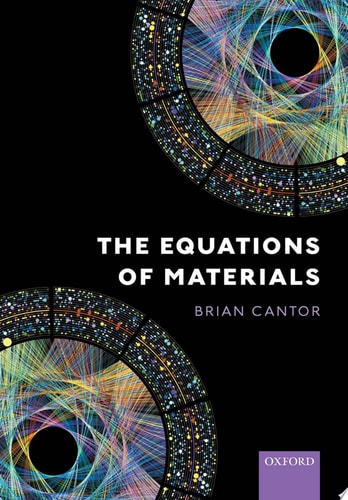
The Equations of Materials
0
0
As an Amazon Associate and affiliate partner, Menrva Books earns from qualifying purchases. Learn more
Author Description
This primer describes important equations of materials and the scientists who derived them. It provides an excellent introduction to the subject by making the material accessible and enjoyable. The book is dedicated to a number of propositions: 1. The most important equations are often simple and easily explained; 2. The most important equations are often experimental, confirmed time and again; 3. The most important equations have been derived by remarkable scientists who lived interesting lives. Each chapter covers a single equation and materials subject, and is structured in three sections: first, a description of the equation itself; second, a short biography of the scientist after whom it is named; and third, a discussion of some of the ramifications and applications of the equation. The biographical sections intertwine the personal and professional life of the scientist with contemporary political and scientific developments. Topics included are: Bravais lattices and crystals; Bragg's law and diffraction; the Gibbs phase rule and phases; Boltzmann's equation and thermodynamics; the Arrhenius equation and reactions; the Gibbs-Thomson equation and surfaces; Fick's laws and diffusion; the Scheil equation and solidification; the Avrami equation and phase transformations; Hooke's law and elasticity; the Burgers vector and plasticity; Griffith's equation and fracture; and the Fermi level and electrical properties. The book is written for students interested in the manufacture, structure, properties and engineering application of materials such as metals, polymers, ceramics, semiconductors and composites. It requires only a working knowledge of school maths, mainly algebra and simple calculus.
Menrva's Summary
THE THESIS
This book investigates the fundamental mathematical relationships governing material properties by examining the scientists who formulated them. Professor Brian Cantor presents a framework that links core physical equations to the historical context and personal lives of their discoverers. The text argues that the most significant equations in materials science are characterized by their simplicity, experimental validity, and the compelling narratives of the individuals who derived them.
THE SCOPE MAP
What You Will Find
- Detailed explanations of foundational equations including Bragg's law, Fick's laws, and the Arrhenius equation.
- Biographical sketches of key scientists, contextualized within their contemporary political and scientific environments.
- Practical applications of these equations in fields such as metallurgy, semiconductors, and polymer science.
Scope Limits
- The text assumes a foundational knowledge of algebra and basic calculus.
- It does not provide exhaustive derivations or advanced theoretical proofs beyond the scope of an introductory primer.
THE AUTHORITY PERSPECTIVE
Experts recognize this work as an accessible entry point for students seeking to bridge the gap between abstract mathematical formulas and their real-world material applications. Readers frequently note that the integration of biographical history makes the technical content more engaging for those new to the discipline.
Page Count:
336
Publication Date:
2020-01-01
Publisher:
OUP Oxford
ISBN-10:
0192592912
ISBN-13:
9780192592910
Biography
Science
Earth Sciences
Science History
Physics
Engineering
Community Tags
Similar Books