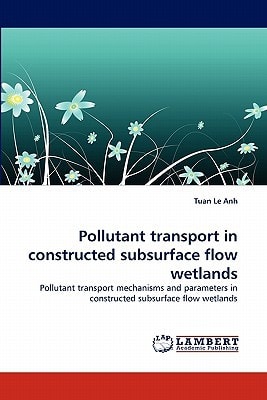
Pollutant Transport in Constructed Subsurface Flow Wetlands
0
0
As an Amazon Associate and affiliate partner, Menrva Books earns from qualifying purchases. Learn more
Author Description
Pollutant transport mechanisms and parameters in constructed subsurface flow wetlands. In recent years, there has been an increasing trend towards the application of constructed wetland wastewater treatment as a decentralized wastewater management solution. Small scale approaches for domestic wastewater treatment offer alternatives that adapt the different sustainability considerations including low cost design installation, operation and maintenance. The design of a constructed wetland should be not only environmentally sound but also economical. The research purpose is to gain an insight into its internal working with focus on the hydraulic regime. To achieve a better understanding of pollutant transport mechanisms and parameters in a sand bed, a physical horizontal sand column model and an experimental constructed subsurface flow wetland were developed. These studies provide new insights on the inner functioning of the constructed wetland and allowed to make recommendation for a constructed subsurface flow wetland design in the Mekong Delta.
Menrva's Summary
THE THESIS
This book investigates the mechanisms and parameters governing pollutant transport within constructed subsurface flow wetlands. The author, Tuan Le Anh, addresses the growing trend of using constructed wetlands for decentralized wastewater management, emphasizing their cost-effectiveness and environmental benefits. Through the development of a physical sand column model and an experimental constructed wetland, the research aims to provide a deeper understanding of the hydraulic regime and pollutant transport within sand beds. The findings offer new insights into the internal functioning of these systems and propose recommendations for their design, particularly for applications in the Mekong Delta.
THE SCOPE MAP
- Analysis of pollutant transport mechanisms in constructed subsurface flow wetlands.
- Examination of key parameters influencing pollutant movement in wetland systems.
- Development and use of a physical horizontal sand column model for research.
- Experimental setup of a constructed subsurface flow wetland for data collection.
- Focus on the hydraulic regime and its impact on treatment efficiency.
- Application of findings to domestic wastewater treatment challenges.
- Recommendations for constructed subsurface flow wetland design in the Mekong Delta region.
THE AUTHORITY PERSPECTIVE
The research presented in this book offers a detailed examination of pollutant transport in constructed subsurface flow wetlands, a critical aspect of decentralized wastewater management. The methodology, involving both physical models and experimental wetlands, provides a robust framework for understanding the complex processes at play. The findings are particularly relevant for regions like the Mekong Delta, where such sustainable treatment solutions are increasingly important. The work contributes valuable data and practical recommendations for the effective design and implementation of these eco-friendly systems.
Page Count:
176
Publication Date:
2011-05-01
Publisher:
Lap Lambert Academic Publishing GmbH KG
ISBN-10:
3844331972
ISBN-13:
9783844331974
Science
Non-Fiction
Pollution Control
Water Treatment
Community Tags
Similar Books