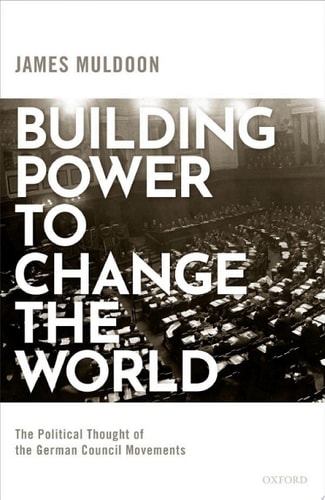
Building Power to Change the World: The Political Thought of the German Council Movements
0
0
As an Amazon Associate and affiliate partner, Menrva Books earns from qualifying purchases. Learn more
Author Description
The German council movements arose through mass strikes and soldier mutinies towards the end of the First World War. They brought down the German monarchy, founded several short-lived council republics, and dramatically transformed European politics. Building Power to Change the World reconstructs how participants in the German council movements struggled for a democratic socialist society. It examines their attempts to democratize politics, the economy, and society through building powerful worker-led organisations and cultivating workers' political agency. Drawing from the practices of the council movements and the writings of theorists such as Rosa Luxemburg, Anton Pannekoek and Karl Kautsky, Building Power to Change the World returns to their radical vision of a self-determining society and their political program of democratization and socialization. It presents a powerful argument for renewed attention to the political theories of this historical period and for their ongoing relevance for democratic politics today.
Menrva's Summary
THE THESIS
This book investigates the political theories and organizational strategies of the German council movements to determine how they sought to establish a democratic socialist society. James Muldoon, a political theorist, analyzes the historical practices of worker-led organizations during the late First World War period. He synthesizes primary source writings from key figures such as Rosa Luxemburg, Anton Pannekoek, and Karl Kautsky to reconstruct the movement's vision for political and economic democratization. The text argues that these historical experiments in self-determination offer significant insights for contemporary democratic theory and practice.
THE SCOPE MAP
What You Will Find
- Historical analysis of the German council movements following the First World War.
- Examination of worker-led organizational structures and political agency.
- Theoretical synthesis of socialist thinkers including Luxemburg, Pannekoek, and Kautsky.
- Discussion of the transition from monarchy to council republics.
Scope Limits
- The text does not provide a comprehensive military history of the First World War.
- It does not focus on the broader geopolitical outcomes of the Weimar Republic beyond the council movement's specific influence.
THE AUTHORITY PERSPECTIVE
Scholars and political theorists frequently note the book's success in bridging historical narrative with rigorous political theory. Experts highlight this as a valuable resource for those interested in the history of democratic socialism and the practical application of council-based governance.
Page Count:
196
Publication Date:
2020-01-01
Publisher:
OUP Oxford
ISBN-10:
0192598554
ISBN-13:
9780192598554
History
German history
Socialism
European History
Political Theory
Works councils
Community Tags
Similar Books