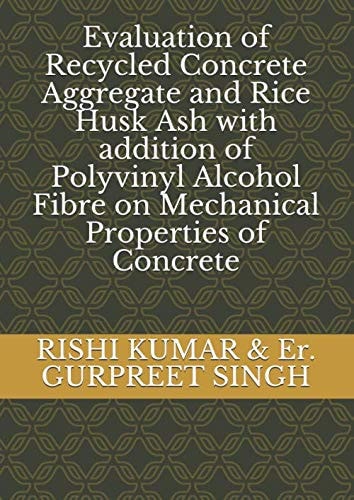
The Use of Black Rice Husk Ash in Concrete
0
0
As an Amazon Associate and affiliate partner, Menrva Books earns from qualifying purchases. Learn more
Author Description
The possibility of using black residual rice husk ash was investigated in this study. The black rice husk ash used was mostly amorphous silica and partially crystalline silica and its mean particle size of 12 um. The black rice husk ash was applied in conventional concrete, self-consolidating concrete, high volume fly ash self consolidating concrete. The concretes were tested for both fresh and hardened stages, i.e. slump, slump flow, electrical resistivity, ultrasonic pulse velocity, chloride ion penetration, sulfate attack, length change, porosity and water absorption. The results show that up to 20% of black rice husk ash could be advantageously blended with cement without adversely affecting the strength and durability properties of both conventional and self-consolidating concretes. The high volume fly ash self consolidating concrete having 28-day compressive strength level of 28.47 44.98 MPa could be obtained with cement content of as low as 152 203 kg/m3 and the amount of fly ash and black rice husk ash of 60% in weight of binder amount. The above results definitively proved many possible applications of the black rice husk in concretes.
Menrva's Summary
THE THESIS
This study investigates the viability of incorporating black rice husk ash as a supplementary cementitious material in concrete formulations. The research examines the properties of black rice husk ash, primarily amorphous and partially crystalline silica with a mean particle size of 12 µm, and its application in conventional concrete, self-consolidating concrete (SCC), and high-volume fly ash SCC. The study details tests conducted on both fresh and hardened concrete properties, including slump, slump flow, electrical resistivity, ultrasonic pulse velocity, chloride ion penetration, sulfate attack, length change, porosity, and water absorption, to assess the impact of this novel material.
THE SCOPE MAP
- Analysis of black rice husk ash composition, focusing on amorphous and crystalline silica content.
- Application of black rice husk ash in conventional concrete mixtures.
- Integration of black rice husk ash into self-consolidating concrete (SCC) formulations.
- Evaluation of high-volume fly ash SCC incorporating black rice husk ash.
- Testing of fresh concrete properties: slump and slump flow.
- Assessment of hardened concrete properties: electrical resistivity, ultrasonic pulse velocity, chloride ion penetration, and sulfate attack resistance.
- Measurement of physical properties: length change, porosity, and water absorption.
- Determination of optimal replacement levels of black rice husk ash for cement without compromising strength and durability.
THE AUTHORITY PERSPECTIVE
The research definitively proves the potential applications of black rice husk ash in concrete, demonstrating that up to 20% replacement of cement can be achieved without negatively impacting strength and durability in both conventional and self-consolidating concretes. Furthermore, the study highlights the possibility of creating high-volume fly ash SCC with significant compressive strength using reduced cement content when combined with black rice husk ash. This work offers valuable insights for sustainable construction practices by utilizing agricultural waste products.
Page Count:
136
Publication Date:
2013-01-01
Publisher:
Lap Lambert Academic Publishing GmbH KG
ISBN-10:
3659318884
ISBN-13:
9783659318887
Non-Fiction
Science
Concrete Technology
Civil Engineering
Construction Materials
Community Tags
Similar Books