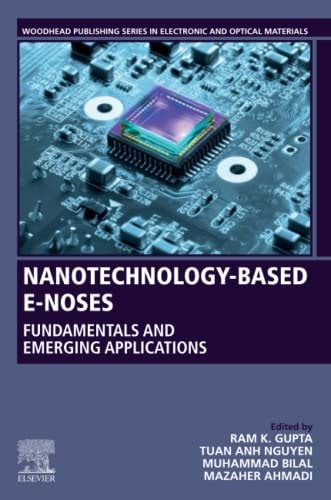
Nanotechnology-Based E-Noses: Fundamentals and Emerging Applications
0
0
As an Amazon Associate and affiliate partner, Menrva Books earns from qualifying purchases. Learn more
Author Description
Nanotechnology-Based E-Noses: Fundamentals and Emerging Applications reviews advances in nanomaterials and their modification for use in e-sensors. Theoretical understanding of nanomaterials and technologies for improving sensors with better detection limits are covered, as are the most relevant nanomaterials, their synthesis strategies and the relationship between properties and device performance. Current state-of-the-art progress in nanotechnology device fabrication, along with directions for future applications and challenges are also discussed. This book will be an ideal resource for materials scientists, engineers, chemists, researchers in academia and R&D in industry. Recently, "e-noses" or "electronic sensors" are emerging as advanced technologies for the fast detection of chemicals, gases and explosives. The concept behind the "e-nose" is similar to the capability of humans and dogs in detecting materials based on odors. Nanomaterials can be used for e-nose technologies but their properties must be modified to make them effective sensors. The sensing capability and performance these materials depend on several factors such as morphology, dopants, micro-additives, design of sensors, phase and structure of the nanomaterials. Covers fundamentals of nanomaterials for electronic sensing applications, including material synthesis and property optimization strategies to improve material performance Reviews emerging relevant nanomaterials including 1D, 2D and 3D nanomaterials for use in e-nose technologies Discusses nanotechnology-based e-noses and their wide range of applications in the detection of chemicals, gases, explosives, and more
Menrva's Summary
THE THESIS
This book investigates the fundamental principles and cutting-edge applications of nanotechnology in the development of electronic noses (e-noses). It provides a comprehensive overview of how nanomaterials are synthesized, modified, and optimized to enhance the sensitivity and selectivity of chemical sensors. The authors explore the critical relationship between the physical and chemical properties of nanomaterials, such as morphology and phase, and their performance in e-nose devices. Furthermore, the text details current advancements in fabrication techniques and outlines future directions and challenges in the field of nanotechnology-based chemical detection.
THE SCOPE MAP
- Fundamentals of nanomaterials for electronic sensing applications.
- Material synthesis and property optimization strategies for improved sensor performance.
- Review of emerging relevant nanomaterials, including 1D, 2D, and 3D structures.
- Modification of nanomaterials for enhanced detection limits in e-sensors.
- Relationship between nanomaterial properties (morphology, phase, structure) and device performance.
- Current state-of-the-art progress in nanotechnology device fabrication.
- Discussion of future applications and challenges in e-nose technology.
- Applications in the detection of chemicals, gases, and explosives.
THE AUTHORITY PERSPECTIVE
This book is positioned as an ideal resource for materials scientists, engineers, chemists, and researchers in academia and industry. The content covers theoretical understanding, practical synthesis strategies, and device performance optimization, suggesting a thorough and informative treatment of the subject. The focus on emerging applications like chemical, gas, and explosive detection highlights its relevance to current technological needs. The comprehensive approach, from fundamentals to future challenges, indicates it aims to be a valuable reference for professionals and researchers in the field.
Page Count:
486
Publication Date:
2023-01-15
Publisher:
Elsevier Science
ISBN-10:
0323911579
ISBN-13:
9780323911573
Non-Fiction
Science & Technology
Science
Engineering
Technology
Chemistry
Community Tags
Similar Books