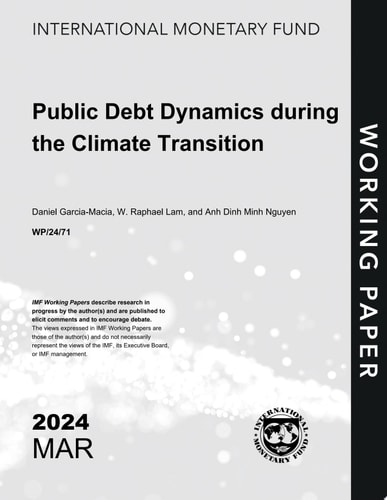
Public Debt Dynamics During the Climate Transition
0
0
As an Amazon Associate and affiliate partner, Menrva Books earns from qualifying purchases. Learn more
Author Description
Managing the climate transition presents policymakers with a tradeoff between achieving climate goals, fiscal sustainability, and political feasibility, which calls for a fiscal balancing act with the right mix of policies. This paper develops a tractable dynamic general equilibrium model to quantify the fiscal impacts of various climate policy packages aimed at reaching net zero emissions by mid-century. Our simulations show that relying primarily on spending measures to deliver on climate ambitions will be costly, possibly raising debt by 45-50 percent of GDP by 2050. However, a balanced mix of carbon-pricing and spending-based policies can deliver on net zero with a much smaller fiscal cost, limiting the increase in public debt to 10-15 percent of GDP by 2050. Carbon pricing is central not only as an effective tool for emissions reduction but also as a revenue source. Delaying carbon pricing action could increase costs, especially if less effective measures are scaled up to meet climate targets. Technology spillovers can reduce the costs but bottlenecks in green investment could unwind the gains and slow the transition.
Menrva's Summary
THE THESIS
The transition to net-zero emissions necessitates a careful balancing act between climate goals, fiscal sustainability, and political feasibility. This paper employs a dynamic general equilibrium model to assess the fiscal implications of various climate policy packages. The analysis reveals that prioritizing spending-based measures alone could lead to a substantial increase in public debt, potentially reaching 45-50 percent of GDP by 2050. Conversely, a diversified approach combining carbon pricing with spending policies can achieve net-zero emissions with a significantly lower fiscal impact, limiting debt increases to 10-15 percent of GDP.
THE SCOPE MAP
- Quantification of fiscal impacts from diverse climate policy packages.
- Analysis of the tradeoff between climate goals, fiscal sustainability, and political feasibility.
- Modeling of net-zero emissions scenarios by mid-century.
- Assessment of the role of carbon pricing as both an emissions reduction tool and a revenue source.
- Impact of policy timing on fiscal costs and effectiveness.
- Consideration of technology spillovers and green investment bottlenecks.
THE AUTHORITY PERSPECTIVE
The analysis presented in this paper suggests that a balanced fiscal approach is crucial for managing the economic challenges of the climate transition. The model indicates that carbon pricing, when integrated with spending-based policies, offers a more fiscally responsible path to achieving net-zero emissions compared to relying solely on expenditure measures. The findings underscore the importance of timely policy implementation and highlight potential risks associated with delays or the scaling up of less efficient measures.
Page Count:
26
Publication Date:
2024-03-29
Publisher:
International Monetary Fund
ISBN-13:
9798400270635
Economics
Non-Fiction
Public Finance
Fiscal Policy
Climate Change
Community Tags
Similar Books