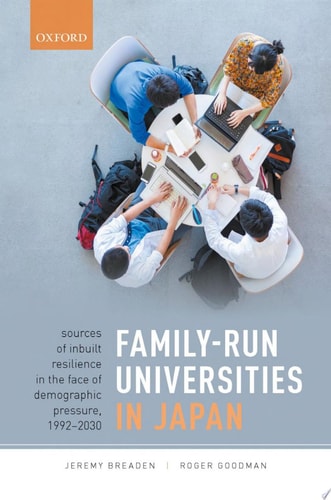
Family-run Universities in Japan
0
0
As an Amazon Associate and affiliate partner, Menrva Books earns from qualifying purchases. Learn more
Author Description
Globally, Private Universities Enrol One In Three Of All Higher Education Students. In Japan, Which Has The Second Largest Higher Education System In The World In Terms Of Overall Expenditure, Almost 80% Of All University Students Attend Private Institutions. According To Some Estimates Up To 40% Of These Institutions Are Family Businesses In The Sense That Members Of A Single Family Have Substantive Ownership Or Control Over Their Operation. This Book Offers A Detailed Historical, Sociological, And Ethnographic Analysis Of This Important, But Largely Under-studied, Category Of Private Universities As Family Business. It Examines How Such Universities In Japan Have Negotiated A Period Of Major Demographic Decline Since The 1990s: Their Experiments In Restructuring And Reform, The Diverse Experiences Of Those Who Worked And Studied Within Them And, Above All, Their Unexpected Resilience. It Argues That This Resilience Derives From A Number Of 'inbuilt' Strengths Of Family Business Which Are Often Overlooked In Conventional Descriptions Of Higher Education Systems And In Predictions Regarding The Capacity Of Universities To Cope With Dramatic Changes In Their Operating Environment. This Book Offers A New Perspective On Recent Changes In The Japanese Higher Education Sector And Contributes To An Emerging Literature On Private Higher Education And Family Business Across The World.
Menrva's Summary
THE THESIS
This book investigates how family-run private universities in Japan have maintained institutional resilience despite significant demographic decline and shifting economic pressures since the 1990s. The authors, Jeremy Breaden and Roger Goodman, utilize a combination of historical analysis, sociological theory, and ethnographic fieldwork to examine the governance structures of these institutions. They argue that the unique characteristics of family-controlled ownership provide specific operational advantages that are frequently ignored by standard higher education management models.
THE SCOPE MAP
What You Will Find
- Historical and sociological analysis of the Japanese private higher education sector.
- Ethnographic case studies of family-run university operations.
- Examination of restructuring and reform strategies implemented during periods of demographic decline.
- Theoretical framework linking family business dynamics to institutional longevity.
Scope Limits
- The study focuses specifically on the Japanese context and does not provide a comprehensive global comparative analysis of all private university systems.
- The research does not cover the internal financial records of every institution mentioned, relying instead on broader institutional trends and qualitative data.
THE AUTHORITY PERSPECTIVE
Experts recognize this work as a significant contribution to the study of private higher education and the intersection of family business models with academic governance. Scholars frequently note that the text provides a necessary, nuanced perspective on the survival strategies of Japanese institutions that are often overlooked in mainstream educational research.
Page Count:
256
Publication Date:
2020-01-01
Publisher:
Oxford University Press
ISBN-10:
019260872X
ISBN-13:
9780192608727
Business
History
Sociology
Family Business
Higher Education
Education
Japan Studies
Community Tags
Similar Books