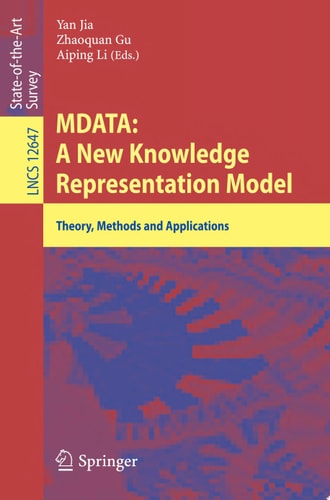
MDATA: A New Knowledge Representation Model
0
0
As an Amazon Associate and affiliate partner, Menrva Books earns from qualifying purchases. Learn more
Author Description
Knowledge representation is an important task in understanding how humans think and learn. Although many representation models or cognitive models have been proposed, such as expert systems or knowledge graphs, they cannot represent procedural knowledge, i.e., dynamic knowledge, in an efficient way. This book introduces a new knowledge representation model called MDATA (Multi-dimensional Data Association and inTelligent Analysis). By modifying the representation of entities and relations in knowledge graphs, dynamic knowledge can be efficiently described with temporal and spatial characteristics. The MDATA model can be regarded as a high-level temporal and spatial knowledge graph model, which has strong capabilities for knowledge representation. This book introduces some key technologies in the MDATA model, such as entity recognition, relation extraction, entity alignment, and knowledge reasoning with spatiotemporal factors. The MDATA model can be applied in many critical applications and this book introduces some typical examples, such as network attack detection, social network analysis, and epidemic assessment. The MDATA model should be of interest to readers from many research fields, such as database, cyberspace security, and social network, as the need for the knowledge representation arises naturally in many practical scenarios.
Menrva's Summary
THE THESIS
The book introduces MDATA, a novel knowledge representation model designed to address the limitations of existing systems in handling dynamic, procedural knowledge. The authors present MDATA (Multi-dimensional Data Association and inTelligent Analysis) as a high-level temporal and spatial knowledge graph model capable of efficiently describing dynamic knowledge with temporal and spatial characteristics by modifying entity and relation representations. The work details key technologies underpinning the MDATA model, including entity recognition, relation extraction, entity alignment, and knowledge reasoning incorporating spatiotemporal factors. Finally, it explores critical applications of the MDATA model, such as network attack detection, social network analysis, and epidemic assessment, demonstrating its practical utility across various research fields.
THE SCOPE MAP
- A novel knowledge representation model called MDATA (Multi-dimensional Data Association and inTelligent Analysis).
- Modifications to entity and relation representations in knowledge graphs for dynamic knowledge.
- Techniques for describing knowledge with temporal and spatial characteristics.
- Key technologies: entity recognition, relation extraction, entity alignment, and knowledge reasoning with spatiotemporal factors.
- Applications in network attack detection.
- Applications in social network analysis.
- Applications in epidemic assessment.
THE AUTHORITY PERSPECTIVE
The book is positioned as a significant contribution to the field of knowledge representation, particularly for researchers and practitioners dealing with dynamic, temporal, and spatial data. Its focus on a novel model, MDATA, suggests it will be of interest to those in database management, cyberspace security, and social network analysis who require advanced methods for understanding complex information. The detailed introduction of key technologies and practical application examples indicates a comprehensive approach for readers seeking to implement or further develop such systems. The work aims to provide a robust framework for intelligent analysis in scenarios where traditional knowledge graphs fall short.
Page Count:
255
Publication Date:
2021-03-06
Publisher:
Springer Nature
ISBN-10:
3030715906
ISBN-13:
9783030715908
Science & Technology
Non-Fiction
Cybersecurity
Databases
Community Tags
Similar Books