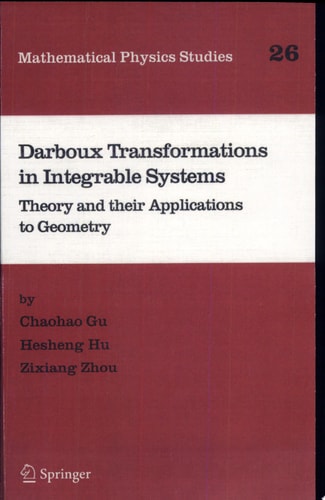
Darboux Transformations in Integrable Systems Theory and Their Applications to Geometry
0
0
As an Amazon Associate and affiliate partner, Menrva Books earns from qualifying purchases. Learn more
Author Description
GU Chaohao The soliton theory is an important branch of nonlinear science. On one hand, it describes various kinds of stable motions appearing in - ture, such as solitary water wave, solitary signals in optical?bre etc., and has many applications in science and technology (like optical signal communication). On the other hand, it gives many e'ective methods ofgetting explicit solutions of nonlinear partial di'erential equations. Therefore, it has attracted much attention from physicists as well as mathematicians. Nonlinearpartialdi'erentialequationsappearinmanyscienti'cpr- lems. Getting explicit solutions is usually a di'cult task. Only in c- tain special cases can the solutions be written down explicitly. However, for many soliton equations, people have found quite a few methods to get explicit solutions. The most famous ones are the inverse scattering method, B] acklund transformation etc.. The inverse scattering method is based on the spectral theory of ordinary di'erential equations. The Cauchyproblemofmanysolitonequationscanbetransformedtosolving a system of linear integral equations. Explicit solutions can be derived when the kernel of the integral equation is degenerate. The B] ac ] klund transformation gives a new solution from a known solution by solving a system of completely integrable partial di'erential equations. Some complicated "nonlinear superposition formula" arise to substitute the superposition principlein linear science.
Menrva's Summary
THE THESIS
This book investigates the theory of Darboux transformations within the context of integrable systems and explores their applications in geometry.
THE SCOPE MAP
- Detailed exposition of Darboux transformations in integrable systems theory.
- Exploration of the applications of these transformations to various areas of geometry.
- Discussion of soliton theory as a significant branch of nonlinear science.
- Explanation of how soliton theory describes stable motions in nature and its technological applications.
- Presentation of effective methods for obtaining explicit solutions to nonlinear partial differential equations.
- Comparison of Darboux transformations with other methods like inverse scattering and Bäcklund transformations.
THE AUTHORITY PERSPECTIVE
The book is positioned as a significant contribution to the study of integrable systems and their geometric applications. It aims to provide a comprehensive understanding of Darboux transformations, a key tool in this field. The text likely appeals to both physicists and mathematicians interested in nonlinear science and differential equations. The authors' expertise suggests a rigorous and detailed treatment of the subject matter.
Page Count:
308
Publication Date:
2004-12-08
Publisher:
Springer Science & Business Media
ISBN-10:
1402030878
ISBN-13:
9781402030871
Science
Non-Fiction
Physics
Mathematics
Geometry
Community Tags
Similar Books