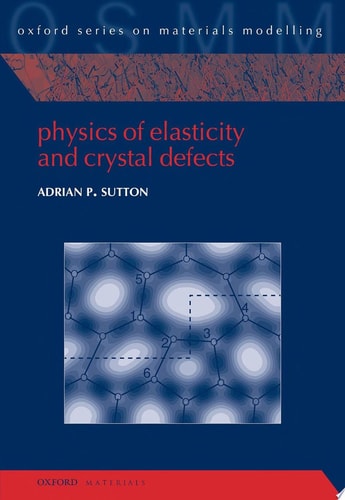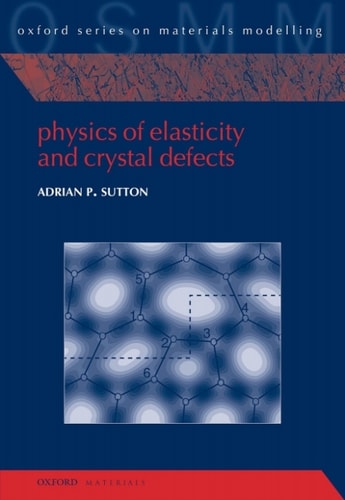
Physics of Elasticity and Crystal Defects
0
0
As an Amazon Associate and affiliate partner, Menrva Books earns from qualifying purchases. Learn more
Author Description
This textbook is a modern take on an old subject at the heart of materials physics. Properties of crystalline materials are almost always controlled by structural defects within them. Until relatively recently these defects were studied theoretically using continuum elasticity theory which ignores the atomic structure of the host material. This book introduces the concepts of elasticity in the traditional continuum way and also in terms of atomic interactions. It goes on to present point (impurities, missing atoms), line (dislocations) and planar (faults, cracks) defects at both the continuum level and the atomic level. This novel approach will be new to most engineers and it will appeal to physicists. There are exercises for the student to work through, with complete solutions free to course instructors from the OUP website.
Menrva's Summary
THE THESIS
This text investigates the relationship between continuum elasticity theory and atomic-scale interactions to explain the behavior of structural defects in crystalline materials. Adrian P. Sutton, a researcher in materials physics, presents a dual-perspective framework that bridges traditional macroscopic elasticity with modern atomic-scale modeling. By integrating these two approaches, the book provides a comprehensive methodology for analyzing how point, line, and planar defects dictate the physical properties of materials.
THE SCOPE MAP
What You Will Find
- Continuum elasticity theory applied to crystalline structures
- Atomic-scale interaction models for material defects
- Analysis of point defects including impurities and vacancies
- Analysis of line defects such as dislocations
- Analysis of planar defects including faults and cracks
- Pedagogical exercises for student application
Scope Limits
- The text focuses primarily on crystalline materials rather than amorphous solids
- It assumes a foundational understanding of physics and mathematics typical of undergraduate or graduate engineering and physics curricula
THE AUTHORITY PERSPECTIVE
Experts and educators recognize this work as a bridge between classical continuum mechanics and modern computational materials science. Readers frequently note the technical density of the prose, which is intended for advanced students and professionals in the field of materials physics.
Page Count:
288
Publication Date:
2020-01-01
Publisher:
OUP Oxford
ISBN-10:
0192605186
ISBN-13:
9780192605184
Physics
Engineering
Earth Sciences
Solid-State Physics