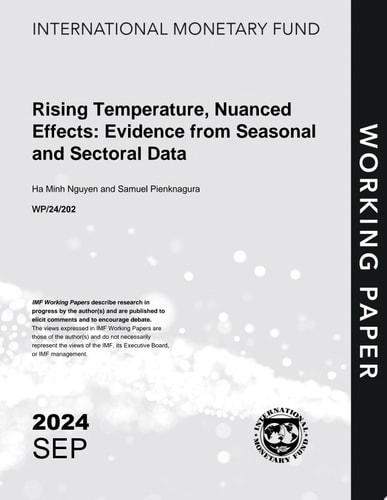
Rising Temperature, Nuanced Effects: Evidence from Seasonal and Sectoral Data
0
0
As an Amazon Associate and affiliate partner, Menrva Books earns from qualifying purchases. Learn more
Author Description
Using quarterly temperature and sectoral value-added data for a large sample of advanced economies (AEs) and emerging markets and developing economies (EMDEs), this paper uncovers nuanced effects of temperature on economic activity. For EMDEs, hotter spring and summer temperatures reduce growth in real value-added of manufacturing, and most significantly, of agriculture, while a warmer winter boosts it. For advanced countries (AEs), a hotter spring hurts growth in real value-added of all considered sectors: services, manufacturing and agriculture. For both country groups, the negative effect of a hotter spring is larger and more persistent than the positive effect of a warmer winter. Furthermore, the adverse impacts of hotter temperatures in advanced economies have accentuated in recent decades. This result suggests increased vulnerability to rising temperatures.
Menrva's Summary
THE THESIS
This paper investigates the complex and varied impacts of rising global temperatures on economic activity across different sectors and economies. The research utilizes quarterly temperature and sectoral value-added data from a broad range of advanced economies (AEs) and emerging markets and developing economies (EMDEs) to reveal how seasonal temperature fluctuations affect growth. It finds that while warmer winters can benefit EMDEs, particularly in agriculture, hotter spring and summer months negatively impact manufacturing and agriculture in these regions. For advanced economies, hotter springs consistently harm services, manufacturing, and agriculture, with these adverse effects becoming more pronounced in recent decades, suggesting a growing vulnerability.
THE SCOPE MAP
- Analysis of quarterly temperature data against sectoral value-added for advanced economies (AEs) and emerging markets and developing economies (EMDEs).
- Identification of seasonal temperature effects on economic growth in agriculture, manufacturing, and services sectors.
- Distinction between the impacts of hotter spring/summer temperatures versus warmer winter temperatures.
- Quantification of the negative effect of hotter springs and the positive effect of warmer winters, including their persistence.
- Examination of trends in the adverse impacts of hotter temperatures in advanced economies over recent decades.
- Evidence suggesting increased economic vulnerability to rising global temperatures.
THE AUTHORITY PERSPECTIVE
The research presented in this paper offers a detailed, data-driven analysis of temperature's economic consequences, differentiating effects by season, sector, and economic development level. By employing a large sample of quarterly data, the study provides nuanced insights into how climate change may differentially affect global economic landscapes. The findings highlight a growing vulnerability in advanced economies to hotter temperatures, suggesting that the economic repercussions of climate change are not uniform and are intensifying over time. This work contributes to a deeper understanding of the specific mechanisms through which environmental shifts translate into economic outcomes.
Page Count:
30
Publication Date:
2024-09-20
Publisher:
International Monetary Fund
ISBN-13:
9798400289248
Economics
Non-Fiction
Manufacturing
Economic Growth
Services
Climate Change
Agriculture
Community Tags
Similar Books