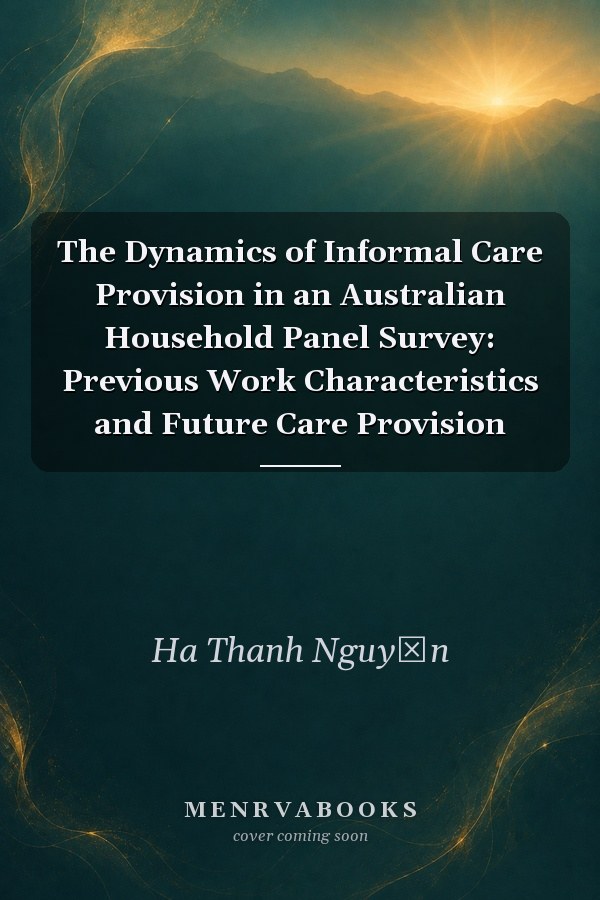
The Dynamics of Informal Care Provision in an Australian Household Panel Survey: Previous Work Characteristics and Future Care Provision
0
0
As an Amazon Associate and affiliate partner, Menrva Books earns from qualifying purchases. Learn more
Author Description
This study contributes to a small literature on the dynamics of informal care by examining the informal care provision choices of working-age Australians. We focus on the impact of previous work characteristics (including work security and flexibility) on subsequent care provision decisions and distinguish between care that is provided to people who cohabit and people who reside elsewhere, as well as between the provision of care as the primary caregiver and provision in a secondary caring role. Our dynamic framework of informal care provision accounts for state dependence, unobserved heterogeneity and initial conditions. For both males and females, we find the existence of positive state dependence in all care states in both the short and medium term. Furthermore, the inertia in care provision appears to be stronger for more intensive care. We also find previous employment status has a significant deterrent effect on current care provision decisions. The effects on employment, however, differ according to the type of previous work, the type of care currently provided, and the gender of the caregiver. We also find that workers with perceptions of greater job security are nevertheless less likely to provide subsequent care. Our results suggest that workers' perceptions about work flexibility and their stated overall satisfaction with work actually have no impact on their subsequent decisions to provide care in any capacity.
Menrva's Summary
THE THESIS
This study investigates the complex interplay between employment characteristics and informal caregiving decisions among working-age Australians. The research examines how factors such as work security and flexibility influence subsequent care provision, differentiating between cohabiting and non-cohabiting care recipients, and primary versus secondary caregiver roles. Utilizing a dynamic framework that accounts for state dependence, unobserved heterogeneity, and initial conditions, the findings reveal significant inertia in care provision, particularly for more intensive care, and a deterrent effect from previous employment status. The study further highlights that perceptions of job security, but not work flexibility or satisfaction, impact future caregiving decisions, with gender and care type mediating employment effects.
THE SCOPE MAP
- Analysis of informal care provision choices among working-age Australians.
- Examination of the impact of previous work characteristics (work security, flexibility) on subsequent care provision.
- Distinction between care provided to cohabiting versus non-cohabiting individuals.
- Differentiation between primary and secondary caregiver roles.
- Application of a dynamic framework accounting for state dependence, unobserved heterogeneity, and initial conditions.
- Findings on positive state dependence in all care states for both males and females.
- Identification of a stronger inertia in care provision for more intensive care.
- Evidence of a significant deterrent effect of previous employment status on current care provision decisions.
THE AUTHORITY PERSPECTIVE
This research contributes to the literature on informal care dynamics by providing empirical evidence from a large Australian household panel survey. The study's rigorous econometric approach allows for nuanced conclusions regarding the factors influencing caregiving decisions, particularly the impact of employment characteristics and the persistence of caregiving roles. The findings suggest that while employment can deter care provision, the specific nature of previous work, the type of care provided, and the caregiver's gender all play significant roles in shaping these outcomes. The research underscores the complexity of balancing work and care responsibilities and offers insights into the inertia and decision-making processes involved.
Page Count:
51
Publication Date:
2016-01-01
Publisher:
Bankwest Curtin Economics Centre
ISBN-10:
1925083535
ISBN-13:
9781925083538
Economics
Self-help
Non-Fiction
Caregiving
Social Science
Sociology
Community Tags
Similar Books