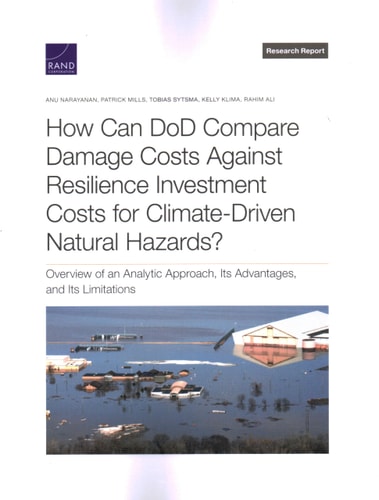
How Can DoD Compare Damage Costs Against Resilience Investment Costs for Climate-Driven Natural Hazards? Overview of an Analytic Approach, Its Advantages, and Its Limitations
0
0
As an Amazon Associate and affiliate partner, Menrva Books earns from qualifying purchases. Learn more
Author Description
U.S. Department of Defense (DoD) installations have been affected by extreme weather events, such as wind and flood damage from Hurricane Sally at Naval Air Station Pensacola and flooding from severe storms at Offutt Air Force Base. More-frequent and less-extreme events, such as recurrent flooding or hailstorms, also disrupt DoD missions and result in considerable financial loss. DoD needs a way to compare the damage costs resulting from extreme weather events against the costs of mitigating that damage through enhanced installation resilience. There is currently no DoD-validated model or method for systematically comparing climate hazard damage costs against the costs of investing in resilience options. This report begins to address this gap by assessing the relevance and limitations of this one analytic approach. Climate change is likely to increase the frequency and/or severity of extreme weather events, but it is difficult to predict with certainty which installations will be hit and when, or even by what type of hazard. It is important for DoD to account for this uncertainty by setting priorities for where and how much to invest in installation resilience to climate-driven hazards. Tools such as the Federal Emergency Management Agency's natural hazard analysis tool (Hazus) could be used to further understanding of the value of investing in installation resilience to climate-driven hazards. In 19 case studies, the annualized cost of a resilience option was compared with the averted damage over that option's lifetime under a variety of disaster scenarios to screen for potentially attractive resilience investment options.
Menrva's Summary
THE THESIS
The U.S. Department of Defense (DoD) lacks a validated model to systematically compare the costs of climate-driven natural hazard damage against investments in installation resilience. This report addresses this gap by assessing one analytic approach, detailing its advantages and limitations. The analysis considers the uncertainty inherent in predicting the frequency, severity, and location of extreme weather events, which are expected to increase due to climate change. It aims to provide a framework for prioritizing resilience investments across DoD installations.
THE SCOPE MAP
- Assessment of an analytic approach for comparing damage costs and resilience investment costs.
- Discussion of the advantages and limitations of the proposed analytic approach.
- Consideration of extreme weather events and their impact on DoD missions and finances.
- Analysis of the uncertainty in predicting climate-driven hazards.
- Evaluation of tools like FEMA's Hazus for understanding resilience investment value.
- Review of 19 case studies comparing annualized resilience option costs with averted damage.
THE AUTHORITY PERSPECTIVE
This report presents a critical analysis of an analytic approach designed to help the Department of Defense (DoD) quantify the financial implications of climate-driven natural hazards. The methodology focuses on comparing the costs of potential damage against the expenses of enhancing installation resilience, a crucial step given the increasing frequency and severity of extreme weather events. By examining the advantages and limitations of this approach, the report aims to inform decision-making processes for prioritizing resilience investments. The inclusion of case studies provides practical context for the proposed framework.
Page Count:
94
Publication Date:
2023-01-01
Publisher:
RAND Corporation
ISBN-10:
197741110X
ISBN-13:
9781977411105
Science & Technology
Non-Fiction
Economics
Climate Change
Community Tags
Similar Books











Reader Comments
Share Your Thoughts
No comments yet. Be the first to share your thoughts!