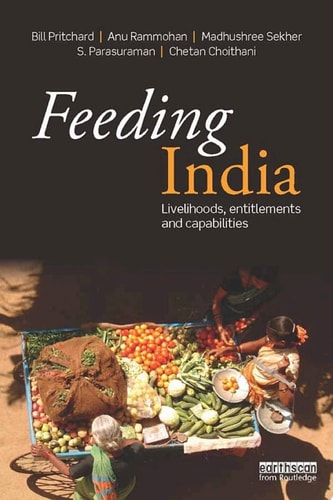
Feeding India
0
0
As an Amazon Associate and affiliate partner, Menrva Books earns from qualifying purchases. Learn more
Author Description
Food security is one of the twenty-first century’s key global challenges, and lessons learned from India have particular significance worldwide. Not only does India account for approximately one quarter of the world’s under-nourished persons, it also provides a worrying case of how rapid economic growth may not provide an assumed panacea to food security. This book takes on this challenge. It explains how India’s chronic food security problem is a function of a distinctive interaction of economic, political and environmental processes. It contends that under-nutrition and hunger are lagging components of human development in India precisely because the interfaces between these aspects of the food security problem have not been adequately understood in policy-making communities. Only through an integrative approach spanning the social and environmental sciences, are the fuller dimensions of this problem revealed. A well-rounded appreciation of the problem is required, informed by the FAO’s conception of food security as encompassing availability (production), access (distribution) and utilisation (nutritional content), as well as by Amartya Sen’s notions of entitlements and capabilities.
Menrva's Summary
THE THESIS
This book investigates the persistent challenge of food security in India, a nation that accounts for a significant portion of the world's undernourished population and demonstrates how economic growth alone does not guarantee food security. It argues that India's chronic food insecurity stems from a complex interplay of economic, political, and environmental factors, which have not been adequately understood by policymakers. The authors advocate for an integrated approach that spans social and environmental sciences to fully grasp the problem's dimensions, incorporating concepts of food availability, access, utilization, entitlements, and capabilities.
THE SCOPE MAP
- Analysis of the economic, political, and environmental drivers of food insecurity in India.
- Exploration of the relationship between rapid economic growth and persistent under-nutrition.
- Discussion of policy-making challenges in addressing food security.
- Integration of FAO's conception of food security (availability, access, utilization).
- Application of Amartya Sen's notions of entitlements and capabilities.
- Case studies and data illustrating India's food security situation.
THE AUTHORITY PERSPECTIVE
The book addresses a critical global challenge, offering lessons from India's experience with food security. It highlights the complex interplay of economic, political, and environmental factors that contribute to persistent under-nutrition, even amidst economic growth. The authors emphasize the need for an integrative approach in policy-making, drawing on established frameworks of food security and human development. This work is positioned as a significant contribution to understanding the multifaceted nature of food insecurity in developing nations.
Page Count:
208
Publication Date:
2013-08-15
Publisher:
Taylor & Francis
ISBN-10:
1136304797
ISBN-13:
9781136304798
Politics
Economics
Non-Fiction
Food security
Public Policy
Community Tags
Similar Books