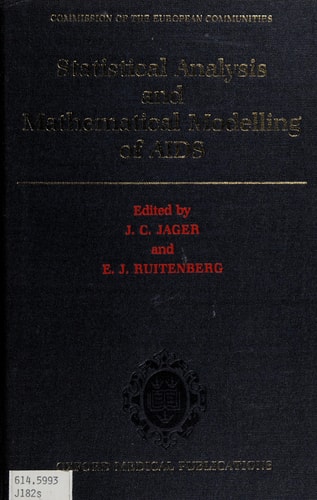
Statistical Analysis and Mathematical Modelling of AIDS
0
0
As an Amazon Associate and affiliate partner, Menrva Books earns from qualifying purchases. Learn more
Author Description
In the worldwide fight against the AIDS epidemic, the ability to predict the number and social impact of future cases plays a vital role. The choice of control strategies, public health decisions, and the evaluation of possible interventions depend on having such information that is accurate and reliable. This book is devoted to the statistical analysis of basic data on the spread of AIDS and the mathematical modelling of the transmission and spread of the human immunodeficiency virus (HIV) which causes the disease. Such techniques take into account medical, psychosocial, behavioral and economic factors, and can help to integrate this information into an efficient methodology for the estimation of future needs and how to meet them. In addition to AIDS specialists, the studies here will be valuable to all those involved in public health, epidemiology and the control of communicable diseases.
Menrva's Summary
THE THESIS
This text investigates the application of statistical analysis and mathematical modeling to predict the trajectory and social impact of the HIV/AIDS epidemic. The authors, E. J. Ruitenberg and J. C. Jager, synthesize data regarding disease transmission to provide a framework for public health officials. By integrating medical, behavioral, and economic variables, the work establishes a methodology for estimating future healthcare needs and evaluating the efficacy of various intervention strategies.
THE SCOPE MAP
What You Will Find
- Mathematical models for HIV transmission dynamics
- Statistical methodologies for analyzing AIDS surveillance data
- Integration of psychosocial and economic factors into epidemiological forecasting
- Frameworks for public health decision-making and resource allocation
Scope Limits
- Does not provide clinical treatment protocols for individual patients
- Focuses on population-level modeling rather than molecular virology
THE AUTHORITY PERSPECTIVE
Experts recognize this volume as a technical resource for epidemiologists and public health professionals involved in communicable disease control. Readers frequently note the academic density of the prose, which assumes a foundational understanding of statistical methods and mathematical modeling.
Page Count:
192
Publication Date:
1988-12-22
Publisher:
Oxford University Press
ISBN-10:
0192617451
ISBN-13:
9780192617453
Mathematics
Epidemiology
Hivaids
Public Health
Statistics
Community Tags
Similar Books