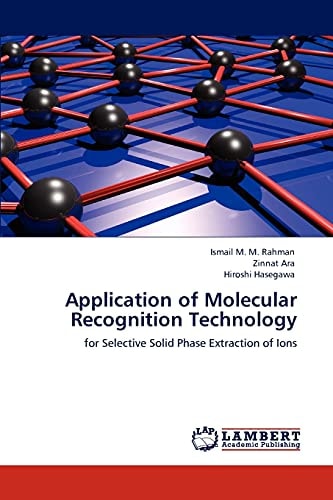
Application of Molecular Recognition Technology
0
0
As an Amazon Associate and affiliate partner, Menrva Books earns from qualifying purchases. Learn more
Author Description
The first application of solid phase extraction (SPE) started approximately five decades ago, and until then development of SPE materials is continued, and it seems to be a never-ending story. Lately, research is focused in developing more explicit materials to achieve meticulous separation of ions from solutions containing complex matrices with high concentrations of interfering ions. One group of SPE materials includes those with macrocyclic ligands immobilized on a silica or polymer support; this type of SPE has been reportedly available for ion-selective separation and pre-concentration of ions, and the technique is commonly known as molecular recognition technology (MRT). In MRT, the designed 'host' materials possess a high degree of recognition to specific ions or groups of ions called 'guest', and the recognition capability remains effective at the very low concentrations of the 'guest' ion or when those present in complex matrices. In this book, application of different MRT-SPE materials for the selective separation of trace ecotoxic ions from the aqueous matrix are described, and the effects of the various chemical species or forms on MRT-based separations are discussed.
Menrva's Summary
THE THESIS
This book investigates the application of molecular recognition technology (MRT) for the selective separation of trace ecotoxic ions from aqueous matrices. The authors detail the development and application of solid phase extraction (SPE) materials featuring immobilized macrocyclic ligands, known as MRT-SPE, which exhibit high recognition capabilities for specific ions ('guests') even in complex solutions. The text discusses the effects of various chemical species on these MRT-based separations, highlighting the ongoing research in developing more explicit materials for meticulous ion separation.
THE SCOPE MAP
- Application of different Molecular Recognition Technology-Solid Phase Extraction (MRT-SPE) materials.
- Selective separation of trace ecotoxic ions from aqueous matrices.
- Discussion on the effects of various chemical species and forms on MRT-based separations.
- Focus on macrocyclic ligands immobilized on silica or polymer supports.
- Explanation of ion-selective separation and pre-concentration techniques.
- Contextualization within the five-decade history of SPE development.
THE AUTHORITY PERSPECTIVE
The book presents a focused exploration of molecular recognition technology (MRT) applied to environmental ion separation. Its detailed discussion of MRT-SPE materials and their effectiveness in complex matrices suggests a valuable resource for researchers in analytical and environmental chemistry. The emphasis on selective separation of ecotoxic ions points to a practical application of advanced chemical techniques for environmental monitoring and remediation.
Page Count:
132
Publication Date:
2011-10-01
Publisher:
Lap Lambert Academic Publishing GmbH KG
ISBN-10:
3846501018
ISBN-13:
9783846501016
Science
Non-Fiction
Chemistry
Analytical Chemistry
Community Tags
Similar Books