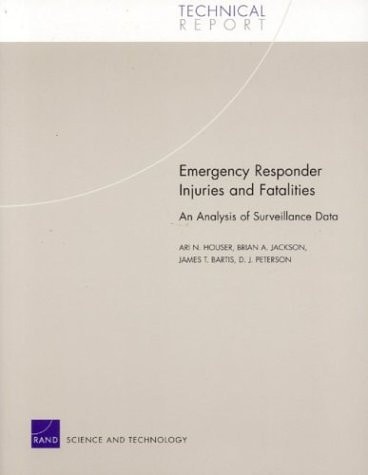
Emergency Responder Injuries and Fatalities: An Analysis of Surveillance Data
0
0
As an Amazon Associate and affiliate partner, Menrva Books earns from qualifying purchases. Learn more
Author Description
The mission of the National Personal Protective Technology Laboratory (NPPTL) is to reduce and prevent occupational disease, injury, and death of workers by advancing federal research on personal protective technologies. NPPTL asked RAND to review available databases that provide disease, injury, and fatality data pertinent to emergency response functions and the role of personal protective technology. This report collects and synthesizes available data on casualties experienced by the emergency responder population for the purpose of estimating the frequency, causes, and characterization of those casualties. The authors examined data separately for firefighters, police officers, and emergency medical technicians (EMTs). They also broke down the data by nature of injury, incidence of injury, activity in which the responder was engaged when injured, and seriousness of injury. The greatest amount of data exist for the firefighter community; a lesser amount for police officers. Data for EMTs are still scarce, but this situation is improving. The available data can provide a route for identifying combinations of kinds and causes of injury, body parts involved, and types of responder activity where injury reduction efforts might be most effectively applied.
Menrva's Summary
THE THESIS
This report analyzes surveillance data to understand the frequency, causes, and characteristics of injuries and fatalities among emergency responders. The National Personal Protective Technology Laboratory (NPPTL) commissioned this review by RAND to examine available databases concerning disease, injury, and fatality data relevant to emergency response functions and the role of personal protective technology. The authors meticulously collected and synthesized casualty data, specifically breaking down the analysis for firefighters, police officers, and emergency medical technicians (EMTs). The report details injuries by their nature, incidence, the activity during which the responder was engaged, and the seriousness of the injury, noting the relative abundance of data for firefighters compared to police officers and the improving, though still scarce, data for EMTs.
THE SCOPE MAP
- Analysis of injury and fatality data for firefighters, police officers, and EMTs.
- Breakdown of casualties by nature of injury, incidence, and responder activity.
- Assessment of the seriousness of injuries sustained by emergency responders.
- Identification of potential areas for effective injury reduction efforts based on data patterns.
- Examination of the role of personal protective technology in emergency responder safety.
THE AUTHORITY PERSPECTIVE
This report provides a comprehensive statistical overview of emergency responder casualties, drawing from existing surveillance data. The analysis highlights disparities in data availability across different emergency service professions, with firefighters having the most extensive data and EMTs the least. The findings are intended to guide targeted interventions for injury reduction by identifying specific activities and injury types where efforts would be most impactful. The study serves as a foundational document for understanding the occupational risks faced by those on the front lines of emergency response.
Page Count:
92
Publication Date:
2004-01-01
Publisher:
RAND
ISBN-10:
0833035657
ISBN-13:
9780833035653
Science & Technology
Non-Fiction
Public Safety
Occupational Health
Emergency services
Data Analysis
Community Tags
Similar Books