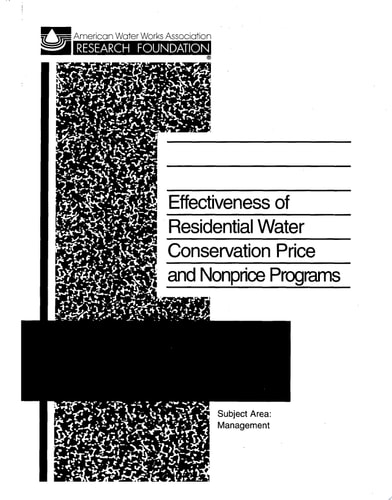
Effectiveness of Residential Water Conservation Price and Nonprice Programs
0
0
As an Amazon Associate and affiliate partner, Menrva Books earns from qualifying purchases. Learn more
Author Description
The purpose of this study is to build upon and extend previous water conservation research efforts of price and nonprice conservation programs on residential water demand in different urban areas of the southwestern United States. The primary research objectives are to: (1) develop residential water demand models to examine the effectiveness of price and nonprice programs; (2) develop and document a database of residential water demand in selected study ares; (3) evaluate the effectiveness of price and nonprice conservation programs using the water demand models and database developed for this study; and (4) examine the applicability of extending regional water demand relationships and results of conservation program effectiveness to other cities in the region. Specific issues examines on regional, seasonal and individual city basis include: How responsive are consumers to changes in the price of water?; are consumers responding to the average price, marginal price, or some combination of the two?; How does demand change or respond to implementation of nonprice conservation program? Is it appropriate to model and apply results on effectiveness to other cities in the region? The scope in terms of number and cross section of cities, detail of observations (monthly time periods), length of time covered and inclusion of price and nonprice programs combined with the analytical techniques used, contribute to making his one of the most comprehensive studies conducted on residential water use and the effectiveness of conservation programs. The research techniques and results of this evaluation will benefit water utilities and consumers through lower costs and more secure water supplies because of improved understanding and better planning and implementation of residential price, rate structure and nonprice conservation programs.
Menrva's Summary
THE THESIS
This study investigates the effectiveness of residential water conservation strategies, focusing on both pricing mechanisms and non-price incentives in urban areas of the southwestern United States. The research aims to develop and validate models of residential water demand, create a comprehensive database for selected study areas, and rigorously evaluate the impact of various conservation programs. Key questions addressed include consumer responsiveness to water price changes (average vs. marginal), the effect of non-price conservation initiatives, and the applicability of regional findings to other municipalities. The study's extensive scope, encompassing multiple cities, detailed monthly observations, and the combined analysis of price and non-price programs, positions it as a significant contribution to understanding residential water use and conservation program efficacy.
THE SCOPE MAP
- Development of residential water demand models to assess price and non-price conservation program effectiveness.
- Creation and documentation of a database for residential water demand in selected southwestern US urban areas.
- Evaluation of price and non-price conservation programs using developed water demand models and database.
- Analysis of the applicability of regional water demand relationships and conservation program effectiveness results to other cities.
- Examination of consumer responsiveness to changes in water price, distinguishing between average and marginal pricing.
- Assessment of how demand changes in response to the implementation of non-price conservation programs.
- Investigation into the appropriateness of modeling and applying conservation effectiveness results across different cities within a region.
THE AUTHORITY PERSPECTIVE
This comprehensive study offers valuable insights for water utilities and policymakers by providing a detailed analysis of residential water conservation programs. The research methodology, which integrates price and non-price strategies across multiple urban areas, is designed to yield robust findings on consumer behavior and program effectiveness. The detailed database and analytical techniques employed are intended to improve planning and implementation of conservation initiatives, ultimately benefiting both utilities through better resource management and consumers through potentially lower costs and more secure water supplies. The study's focus on regional applicability also aims to provide transferable knowledge for broader water resource management.
Page Count:
128
Publication Date:
1998-01-01
Publisher:
American Water Works Association
ISBN-10:
0898679540
ISBN-13:
9780898679540
Non-Fiction
Science & Technology
Economics
urban planning
Water Conservation
Community Tags
Similar Books





Reader Comments
Share Your Thoughts
No comments yet. Be the first to share your thoughts!