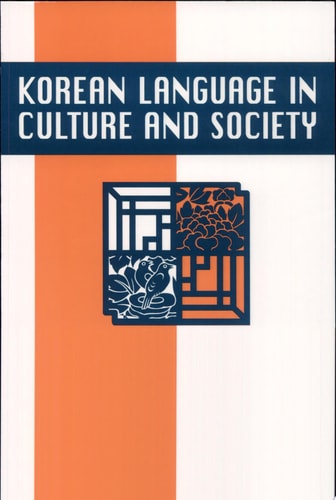
Korean Language in Culture and Society
0
0
As an Amazon Associate and affiliate partner, Menrva Books earns from qualifying purchases. Learn more
Author Description
Intended as a companion to the popular KLEAR Textbooks in Korean Language series and designed and edited by a leading Korean linguist, this is the first volume of its kind to treat specifically the critical role of language in Korean culture and society. An introductory chapter provides the framework of the volume, defining language, culture, and society and their interrelatedness and presenting an overview of the Korean language vis-à-vis its culture and society from evolutionary and dynamic perspectives. Early on, contributors examine the invention and use of the Korean alphabet, South Korea’s "standard language" vs. North Korea’s "cultured language," and Korean in contact with Chinese and Japanese. Several topics representative of Korean socio-cultural vocabulary (sound symbolic words, proverbs, calendar-related terms, kinship terms, slang expressions) are discussed, followed by a consideration of Korean honorifics and other related issues. Two chapters on Korean media, one on advertisements and the other a comparative analysis of television ads in Korea, Japan, and the U.S., follow. Finally, contributors look at salient features of the language, narrative structure, and dialectal variation. All chapters are accompanied by a set of student questions and a useful bibliography. A beginning level of proficiency in Korean is sufficient to digest the Korean examples with facility, making this volume accessible to a wide range of students. Contributors: Andrew S. Byon, Sungdai Cho, Young-A Cho, Young-mee Y. Cho, Miho Choo, Shin Ja J. Hwang, Ross King, Haejin Elizabeth Koh, Jeyseon Lee, Douglas Ling, Duk-Soo Park, Yong-Yae Park, S. Robert Ramsey, Carol Schulz, Ho-min Sohn, Susan Strauss, Hye-Sook Wang, Jaehoon Yeon.
Menrva's Summary
THE THESIS
This volume investigates the intricate relationship between the Korean language and its cultural and societal contexts. It is structured around an introductory chapter that defines the core concepts of language, culture, and society and their interdependencies, setting a framework for understanding the Korean language from evolutionary and dynamic perspectives. Subsequent chapters explore the Korean alphabet, the distinctions between North and South Korean standard languages, and the influence of Chinese and Japanese on Korean. The book further delves into socio-cultural vocabulary, honorifics, media representations, narrative structures, and dialectal variations, making it accessible to students with a basic proficiency in Korean.
THE SCOPE MAP
- An examination of the invention and use of the Korean alphabet (Hangul).
- A comparative analysis of South Korea's "standard language" and North Korea’s "cultured language."
- Discussion of Korean language in contact with Chinese and Japanese.
- Exploration of socio-cultural vocabulary, including sound symbolic words, proverbs, kinship terms, and slang.
- Detailed consideration of Korean honorifics and related linguistic phenomena.
- Analysis of Korean media, with chapters on advertisements and a comparative study of television ads across Korea, Japan, and the U.S.
- An overview of salient features of the language, narrative structure, and dialectal variation.
THE AUTHORITY PERSPECTIVE
As a companion to the KLEAR Textbooks in Korean Language series, this volume is designed by a leading Korean linguist to be the first of its kind to specifically address the critical role of language in Korean culture and society. The inclusion of student questions and bibliographies at the end of each chapter suggests an academic or advanced learner focus. The accessibility for students with a beginning level of Korean proficiency indicates a pedagogical intent, aiming to bridge linguistic study with cultural understanding.
Page Count:
284
Publication Date:
2005-12-31
Publisher:
University of Hawaii Press
ISBN-10:
0824826949
ISBN-13:
9780824826949
Literary Fiction
Non-Fiction
Culture
Linguistics
Korean Studies
Community Tags
Similar Books