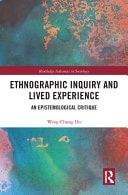
Ethnographic Inquiry and Lived Experience: An Epistemological Critique
0
0
As an Amazon Associate and affiliate partner, Menrva Books earns from qualifying purchases. Learn more
Author Description
Ho addresses two fundamental theoretical questions about how best to practice ethnographic inquiries to obtain qualitative, experience-near, and shareable accounts of human living. The first question is regarding the epistemology of ethnography. Ho posits that writing is epistemologically prior to the researcher's fieldwork experience in the production of ethnographic knowledge. This stance is developed using the theories of hermeneutics put forward by Paul Ricoeur and Hans-Georg Gadamer who both consider that once a text is produced, its meaning is dissociated from the intention of the author. The second question is: what is the putative object that the ethnographer writes about? Ho argues that "lived experience" (Erlebnis) offers such an ethnographic object. Since the lived experience that an ethnographer experiences during fieldwork cannot be studied directly, further theorizations of lived experience are necessary. Ho underscores both the non-discursivity and transcendence of lived experience in the lifeworld, and the way power is clandestinely imbued in everyday life in shaping subjectivity and practice. This theorization brings together Alfred Schutz's lifeworld theory and Michel Foucault's power/knowledge nexus. The result is a general theory of experience that is pertinent for ethnographic inquiries. By addressing these two fundamental questions and offering novel angles from which to answer them, this book offers refreshed epistemological guidelines for conducting ethnographic research for scientific reasoning. More importantly, this book also provides a crucial knowledge base for comprehending the current epistemological debates inherent in the production of ethnographic knowledge and furthering discussions in the field.
Menrva's Summary
THE THESIS
This book critically examines the epistemological foundations of ethnographic inquiry and the concept of 'lived experience' as its object. The author, Wing Chung Ho, addresses two core theoretical questions: the epistemology of ethnography and the nature of its object of study. Ho argues that writing precedes fieldwork in knowledge production, drawing on hermeneutic theories from Ricoeur and Gadamer. Furthermore, the book posits 'lived experience' as the ethnographic object, integrating Schutz's lifeworld theory with Foucault's power/knowledge nexus to theorize its non-discursive and transcendent qualities, and its subjection to power.
THE SCOPE MAP
- An epistemological critique of ethnographic inquiry, positing writing as prior to fieldwork.
- Theorization of 'lived experience' (Erlebnis) as the object of ethnographic study.
- Integration of hermeneutic theories from Paul Ricoeur and Hans-Georg Gadamer.
- Synthesis of Alfred Schutz's lifeworld theory and Michel Foucault's power/knowledge nexus.
- Analysis of the non-discursivity and transcendence of lived experience.
- Exploration of how power shapes subjectivity and practice within everyday life.
- Refreshed epistemological guidelines for conducting ethnographic research.
THE AUTHORITY PERSPECTIVE
This book is positioned as a significant contribution to the theoretical underpinnings of ethnographic research. By engaging with foundational thinkers in hermeneutics and social theory, it aims to provide a robust epistemological framework for qualitative research. The work is likely to be of interest to scholars and students grappling with the philosophical challenges of representing human experience and the influence of power dynamics within ethnographic accounts. It offers a novel perspective on how to approach and understand the complexities of lived experience in academic study.
Page Count:
204
Publication Date:
2019-01-01
Publisher:
Routledge
ISBN-10:
1351064029
ISBN-13:
9781351064026
Philosophy
Non-Fiction
Sociology
Research Methods
Community Tags
Similar Books