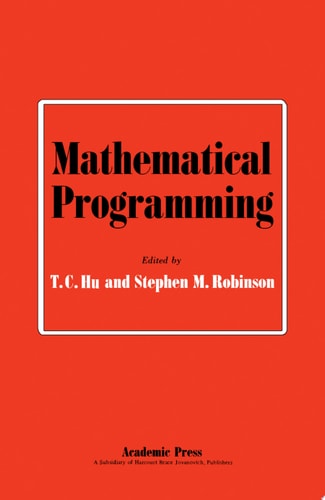
Mathematical Programming
0
0
As an Amazon Associate and affiliate partner, Menrva Books earns from qualifying purchases. Learn more
Author Description
Mathematical Programming provides information pertinent to the developments in mathematical programming. This book covers a variety of topics, including integer programming, dynamic programming, game theory, nonlinear programming, and combinatorial equivalence. Organized into nine chapters, this book begins with an overview of optimization of very large-scale planning problems that can be achieved on significant problems. This text then introduces non-stationary policies and determines certain operating characteristics of the optimal policy for a very long planning horizon. Other chapters consider the perfect graph theorem by defining some well-known integer-valued functions of an arbitrary graph. This book discusses as well integer programming that deals with the class of mathematical programming problems in which some or all of the variables are required to be integers. The final chapter deals with the basic theorem of game theory. This book is a valuable resource for readers who are interested in mathematical programming. Mathematicians will also find this book useful.
Menrva's Summary
THE THESIS
This book investigates the diverse landscape of mathematical programming and its applications. It delves into various optimization techniques, including integer programming, dynamic programming, game theory, and nonlinear programming, presenting them through a structured nine-chapter framework. The text begins by exploring large-scale planning problems and then moves to dynamic programming concepts for long planning horizons. Subsequent chapters address graph theory, integer programming specifics, and conclude with the fundamental theorem of game theory, offering a comprehensive overview for mathematicians and those interested in the field.
THE SCOPE MAP
- Overview of optimization for very large-scale planning problems.
- Introduction to non-stationary policies and optimal policy characteristics for long planning horizons.
- Discussion of the perfect graph theorem and integer-valued functions of graphs.
- Detailed examination of integer programming where variables must be integers.
- Exploration of dynamic programming principles.
- Coverage of game theory, including its basic theorem.
- Introduction to nonlinear programming techniques.
- Discussion of combinatorial equivalence.
THE AUTHORITY PERSPECTIVE
This book is presented as a valuable resource for individuals engaged with mathematical programming, including mathematicians and researchers. The content covers a broad spectrum of optimization techniques, suggesting it serves as a comprehensive reference or textbook. Its structured approach, moving from large-scale problems to specific theorems, indicates a pedagogical design aimed at building understanding across different facets of the field. The inclusion of diverse topics like game theory and graph theory alongside core programming methods points to its utility for those seeking a broad yet detailed understanding of mathematical optimization.
Page Count:
308
Publication Date:
2014-05-10
Publisher:
Elsevier S & T
ISBN-10:
1483260798
ISBN-13:
9781483260792
Science
Non-Fiction
Operations Research
Optimization
Mathematics
Community Tags
Similar Books