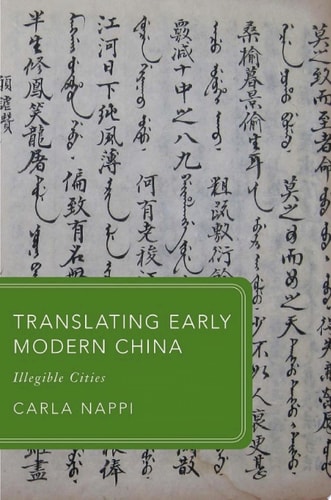
Translating Early Modern China: Illegible Cities
0
0
As an Amazon Associate and affiliate partner, Menrva Books earns from qualifying purchases. Learn more
Author Description
The history of China, as any history, is a story of and in translation. Translating Early Modern China tells the story of translation in China to and from non-European languages and Latin between the fourteenth and the nineteenth centuries, and primarily in the Ming and Qing dynasties. Each chapter finds a particular translator resurrected from the past to tell the story of a text that helped shape the history of translation in China. In Chinese, Mongolian, Manchu, Latin, and more, these texts helped to make the Chinese language what it was at different points in its history. This volume explores what the form of an academic history book might look like by playing with fictioning as part of the historian's craft. The book's many stories—of glossaries and official Ming translation bureaus, of bilingual Ming Chinese-Mongolian language primers, of the first Latin grammar of Manchu, of a Qing Manchu conversation manual, of a collection of Manchu poems by a Qing translator—serve as case studies that open out into questions of language and translation in China's past, of the use of fiction as a historian's tool, and of the ways that translation creates language.
Menrva's Summary
THE THESIS
This book investigates how the history of China is fundamentally a history of translation, specifically examining the linguistic exchanges between Chinese and non-European languages and Latin from the fourteenth to the nineteenth centuries. Prof. Carla Nappi, a historian of science and medicine, utilizes a methodology that blends rigorous archival research with 'fictioning'—a narrative technique that reconstructs the lives of historical translators to explore the evolution of language. By focusing on the Ming and Qing dynasties, the author argues that translation was not merely a peripheral activity but a central force in shaping the Chinese language and the historical record itself.
THE SCOPE MAP
What You Will Find
- Analysis of Ming translation bureaus and official linguistic practices.
- Examination of bilingual Ming Chinese-Mongolian language primers.
- Study of the first Latin grammar of Manchu and Qing-era conversation manuals.
- Exploration of the intersection between historical methodology and creative narrative techniques.
Scope Limits
- The text does not provide a comprehensive survey of all translation activities in China, focusing instead on specific case studies.
- It does not prioritize European-to-Chinese translation, focusing primarily on non-European and Latin interactions.
THE AUTHORITY PERSPECTIVE
Scholars in the field of Asian studies and historiography frequently note the innovative structure of this work, which challenges traditional academic writing conventions by incorporating narrative fictioning. Experts highlight the book as a significant contribution to understanding how translation practices actively constructed the linguistic identity of early modern China.
Page Count:
250
Publication Date:
2021-01-01
Publisher:
OUP Oxford
ISBN-10:
019263626X
ISBN-13:
9780192636263
History
China
Linguistics
Historiography
Translation Studies
English
Asian Studies
English & College Success
History - Modern
Community Tags
Similar Books