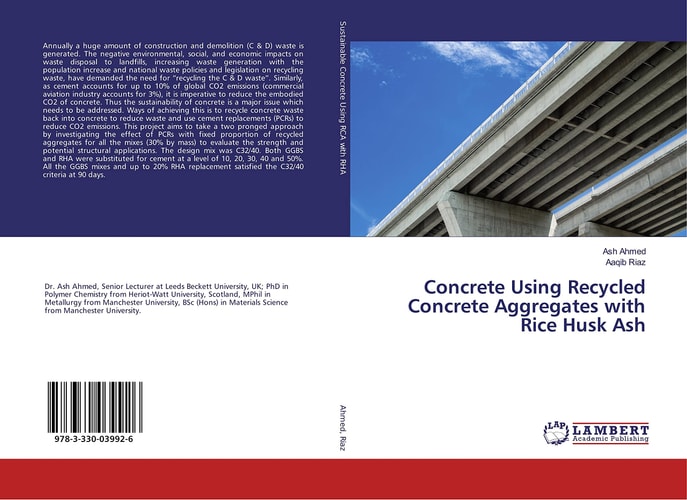
Concrete Using Recycled Concrete Aggregates with Rice Husk Ash
0
0
As an Amazon Associate and affiliate partner, Menrva Books earns from qualifying purchases. Learn more
Author Description
Annually a huge amount of construction and demolition (C & D) waste is generated. The negative environmental, social, and economic impacts on waste disposal to landfills, increasing waste generation with the population increase and national waste policies and legislation on recycling waste, have demanded the need for “recycling the C & D waste”. Similarly, as cement accounts for up to 10% of global CO2 emissions (commercial aviation industry accounts for 3%), it is imperative to reduce the embodied CO2 of concrete. Thus the sustainability of concrete is a major issue which needs to be addressed. Ways of achieving this is to recycle concrete waste back into concrete to reduce waste and use cement replacements (PCRs) to reduce CO2 emissions. This project aims to take a two pronged approach by investigating the effect of PCRs with fixed proportion of recycled aggregates for all the mixes (30% by mass) to evaluate the strength and potential structural applications. The design mix was C32/40. Both GGBS and RHA were substituted for cement at a level of 10, 20, 30, 40 and 50%. All the GGBS mixes and up to 20% RHA replacement satisfied the C32/40 criteria at 90 days.
Menrva's Summary
THE THESIS
This work investigates methods to mitigate the environmental impact of concrete production and disposal. The authors address the dual challenges of construction and demolition waste generation and the significant CO2 emissions associated with cement production. By exploring the use of recycled concrete aggregates and supplementary cementitious materials like Ground Granulated Blast-furnace Slag (GGBS) and Rice Husk Ash (RHA), this project aims to develop more sustainable concrete mixes. The research focuses on evaluating the strength and potential structural applications of concrete incorporating these recycled components and replacements.
THE SCOPE MAP
- Analysis of construction and demolition (C&D) waste generation and its environmental impact.
- Exploration of strategies for recycling C&D waste in concrete production.
- Investigation into reducing CO2 emissions from cement by using partial cement replacements (PCRs).
- Evaluation of Ground Granulated Blast-furnace Slag (GGBS) as a PCR.
- Evaluation of Rice Husk Ash (RHA) as a PCR.
- Testing of concrete mixes with a fixed proportion (30% by mass) of recycled aggregates.
- Substitution of cement with GGBS and RHA at replacement levels of 10%, 20%, 30%, 40%, and 50%.
- Assessment of concrete strength against the C32/40 criteria at 90 days for various mix designs.
THE AUTHORITY PERSPECTIVE
The research presented in this work addresses critical issues in sustainable construction materials, focusing on the practical application of recycled aggregates and supplementary cementitious materials. The methodology involves systematic testing of concrete mixes with varying proportions of recycled components and cement replacements, aiming to meet specific strength criteria. The findings indicate that certain combinations of GGBS and RHA replacements, alongside recycled aggregates, can satisfy the C32/40 standard, suggesting viable pathways for more environmentally friendly concrete.
Page Count:
100
Publication Date:
2017-02-03
Publisher:
LAP LAMBERT Academic Publishing
ISBN-10:
3330039922
ISBN-13:
9783330039926
Non-Fiction
Science & Technology
Construction
Recycling
Sustainability
Engineering
Community Tags
Similar Books