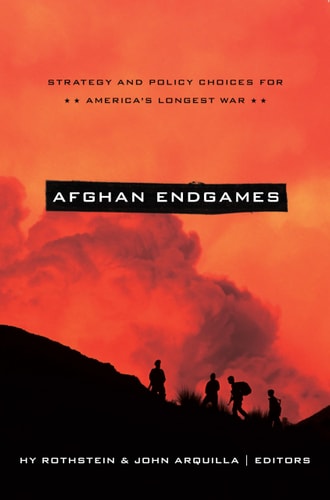
Afghan Endgames: Strategy and Policy Choices for America's Longest War
0
0
As an Amazon Associate and affiliate partner, Menrva Books earns from qualifying purchases. Learn more
Author Description
The United States and its allies have been fighting the Taliban and al-Qaeda in Afghanistan for a decade in a war that either side could still win. While a gradual drawdown has begun, significant numbers of US combat troops will remain in Afghanistan until at least 2014, perhaps longer, depending on the situation on the ground and the outcome of the US presidential election in 2012. Given the realities of the Taliban's persistence and the desire of US policymakers -- and the public -- to find a way out, what can and should be the goals of the US and its allies in Afghanistan? Afghan Endgames brings together some of the finest minds in the fields of history, strategy, anthropology, ethics, and mass communications to provide a clear, balanced, and comprehensive assessment of the alternatives for restoring peace and stability to Afghanistan. Presenting a range of options -- from immediate withdrawal of all coalition forces to the maintenance of an open-ended, but greatly reduced military presence -- the contributors weigh the many costs, risks, and benefits of each alternative. This important book boldly pursues several strands of thought suggesting that a strong, legitimate central government is far from likely to emerge in Kabul; that fewer coalition forces, used in creative ways, may have better effects on the ground than a larger, more conventional presence; and that, even though Pakistan should not be pushed too hard, so as to avoid sparking social chaos there, Afghanistan's other neighbors can and should be encouraged to become more actively involved. The volume's editors conclude that while there may never be complete peace in Afghanistan, a self-sustaining security system able to restore order swiftly in the wake of violence is attainable.
Menrva's Summary
THE THESIS
This book examines the complex strategic and policy choices facing the United States and its allies in the protracted war in Afghanistan.
Edited by Hy Rothstein and John Arquilla, Afghan Endgames brings together experts from diverse fields including history, strategy, anthropology, ethics, and mass communications to offer a comprehensive assessment of the alternatives for achieving peace and stability in Afghanistan. The contributors analyze a spectrum of options, from immediate withdrawal to a reduced, long-term military presence, weighing the costs, risks, and benefits of each. The book challenges the assumption that a strong central government in Kabul is likely, suggesting that a smaller, more creatively employed coalition force might be more effective than a larger conventional presence. It also explores the potential for greater involvement from Afghanistan's neighbors, while cautioning against overly pressuring Pakistan.
THE SCOPE MAP
- Analysis of various US and allied policy options for Afghanistan.
- Contributions from experts in history, strategy, anthropology, ethics, and mass communications.
- Evaluation of different withdrawal scenarios and military presence levels.
- Discussion on the likelihood of establishing a strong central government in Kabul.
- Exploration of alternative military strategies, including smaller, more creative force deployments.
- Consideration of the role of Afghanistan's neighbors and the impact on Pakistan.
- Conclusion that a self-sustaining security system is attainable, even if complete peace is not.
THE AUTHORITY PERSPECTIVE
The book presents a balanced and comprehensive assessment of the complex situation in Afghanistan, drawing on a multidisciplinary approach. Contributors offer a range of strategic and policy alternatives, challenging conventional wisdom regarding government stability and military effectiveness. The analysis considers the practical implications of different withdrawal timelines and force postures. Ultimately, the volume suggests that while a complete resolution may be elusive, a functional security system for Afghanistan is an achievable objective.
Page Count:
248
Publication Date:
2012-01-06
Publisher:
Georgetown University Press
ISBN-10:
1589019083
ISBN-13:
9781589019089
History
Non-Fiction
Politics
Military Strategy
Community Tags
Similar Books