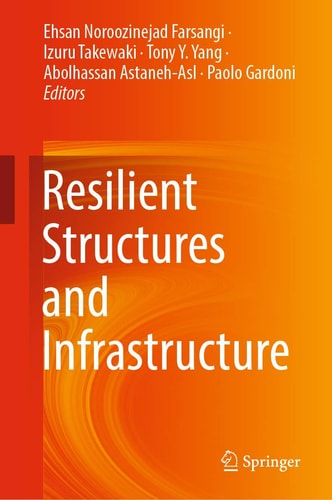
Resilient Structures and Infrastructure
0
0
As an Amazon Associate and affiliate partner, Menrva Books earns from qualifying purchases. Learn more
Author Description
This book discusses resilience in terms of structures’ and infrastructures’ responses to extreme loading conditions. These include static and dynamic loads such as those generated by blasts, terrorist attacks, seismic events, impact loadings, progressive collapse, floods and wind. In the last decade, the concept of resilience and resilient-based structures has increasingly gained in interest among engineers and scientists. Resilience describes a given structure’s ability to withstand sudden shocks. In other words, it can be measured by the magnitude of shock that a system can tolerate. This book offers a valuable resource for the development of new engineering practices, codes and regulations, public policy, and investigation reports on resilience, and provides broad and integrated coverage of the effects of dynamic loadings, and of the modeling techniques used to compute the structural response to these loadings.
Menrva's Summary
THE THESIS
This book investigates the critical concept of resilience in structural and infrastructure engineering, focusing on responses to extreme loading conditions. It addresses static and dynamic loads from events like blasts, terrorist attacks, seismic activity, impacts, progressive collapse, floods, and wind. The growing interest in resilience stems from its definition as a structure's ability to withstand sudden shocks, measurable by the magnitude of shock a system can tolerate. This work aims to serve as a vital resource for advancing engineering practices, codes, regulations, public policy, and investigation reports by providing comprehensive coverage of dynamic loading effects and the modeling techniques used to compute structural responses.
THE SCOPE MAP
- Analysis of structural and infrastructure resilience to extreme static and dynamic loads.
- Coverage of loading conditions including blasts, seismic events, impacts, progressive collapse, floods, and wind.
- Discussion on the concept of resilience and its measurement based on shock tolerance.
- Integration of new engineering practices, codes, regulations, and public policy related to resilience.
- Detailed examination of the effects of dynamic loadings.
- Exploration of modeling techniques for computing structural responses to extreme events.
THE AUTHORITY PERSPECTIVE
The subject matter points to a dense, specialist text aimed at engineers and scientists actively involved in structural and infrastructure design and safety. The focus on resilience and extreme loading conditions suggests a practical application of advanced engineering principles, likely appealing to those concerned with disaster preparedness and mitigation. The inclusion of modeling techniques indicates a rigorous, data-driven approach to the topic.
Page Count:
494
Publication Date:
2019-05-15
Publisher:
Springer Nature Singapore
ISBN-10:
9811374457
ISBN-13:
9789811374456
Science & Technology
Non-Fiction
Engineering
Structural Engineering
Civil Engineering
Community Tags
Similar Books