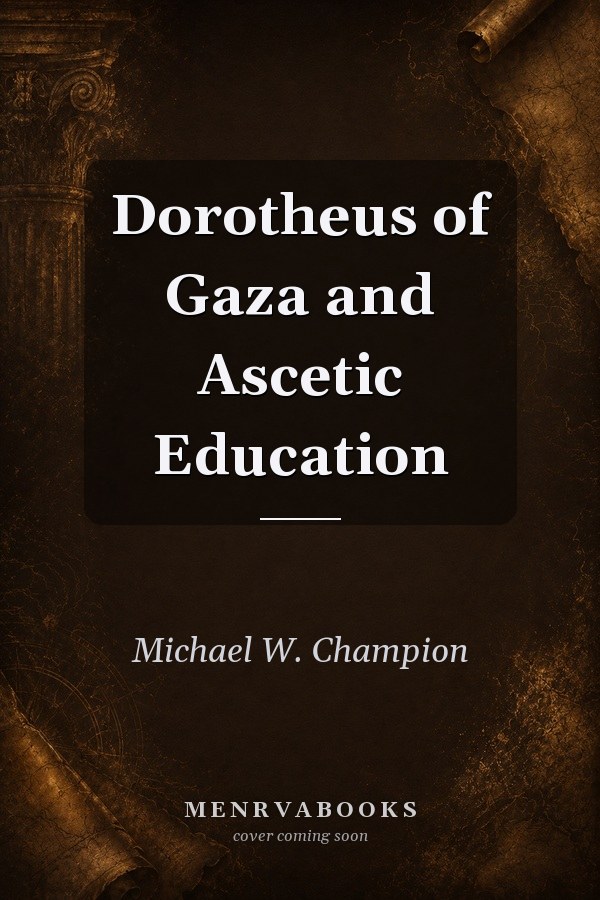
Dorotheus of Gaza and Ascetic Education
0
0
As an Amazon Associate and affiliate partner, Menrva Books earns from qualifying purchases. Learn more
Author Description
Dorotheus of Gaza and Ascetic Education approaches fundamental questions about the role and function of education in late antiquity through a detailed study of the thought of Dorotheus of Gaza, a sixth-century Palestinian monk. It illumines the thought of a significant figure in Palestinian monasticism, clarifies relationships between ascetic and classical education, and contributes to debates about how different educational projects related to late-antique cultural change. Dorotheus appropriates and reconfigures classical discourses of rhetoric, philosophy, and medicine and builds on earlier ascetic traditions. Education is a powerful site for the reconfiguration and reproduction of culture, and Dorotheus' educational programme can be read as a microcosm of the wider culture he aims to construct partly through his adaptation and representation of classical and ascetic discourses. Key features of his educational programme include the role of the notion of godlikeness, the governing role of humility as an epistemic virtue intended to organize affective and ethical development, and his notion of education as life-long habituation. For Dorotheus, education is irreducibly affective and transformative, rather than merely informative, at the individual and communal scales. His epistemology and ethics are set within an account of the divine plan of salvation which is intended to provide a narrative framework through which his students come to understand the world and their place in it. His account of ways of knowing and ordering knowledge, ethics and moral development, emotions of education, and relationships between affect, cognition, and ethical action aims towards transformation of his students and their communities.
Menrva's Summary
THE THESIS
This book investigates the role and function of education in late antiquity through the lens of a sixth-century Palestinian monk. Michael W. Champion's study of Dorotheus of Gaza explores how this significant figure in monasticism integrated classical educational traditions with ascetic principles. The work clarifies the relationships between these two educational paradigms and contributes to understanding cultural change in late antiquity. Dorotheus's educational program, which reconfigures classical rhetoric, philosophy, and medicine, serves as a microcosm of the wider culture he sought to shape.
THE SCOPE MAP
- Analysis of Dorotheus of Gaza's thought on education.
- Exploration of the intersection between ascetic and classical education in late antiquity.
- Examination of Dorotheus's appropriation and reconfiguration of classical discourses (rhetoric, philosophy, medicine).
- Discussion of key features of Dorotheus's educational program, including godlikeness, humility as an epistemic virtue, and lifelong habituation.
- An argument for education as an affective and transformative process, rather than merely informative.
- Consideration of Dorotheus's epistemology and ethics within a framework of divine salvation.
- Analysis of how Dorotheus's ideas on knowledge, ethics, and emotions aim for the transformation of students and their communities.
THE AUTHORITY PERSPECTIVE
The book is likely to be of interest to scholars of late antique history, monasticism, and the history of education. Its detailed study of Dorotheus of Gaza promises to illuminate a key figure and clarify complex relationships between different educational traditions. The analysis of how Dorotheus adapted classical discourses for ascetic purposes offers insights into broader cultural shifts of the period. The work's focus on education as a transformative, affective process suggests a nuanced perspective on the aims and methods of ancient pedagogy.
Page Count:
272
Publication Date:
2022-01-01
Publisher:
Oxford University Press, Incorporated
ISBN-10:
0192640348
ISBN-13:
9780192640345
Philosophy
History
Non-Fiction
Religion
Education
Community Tags
Similar Books