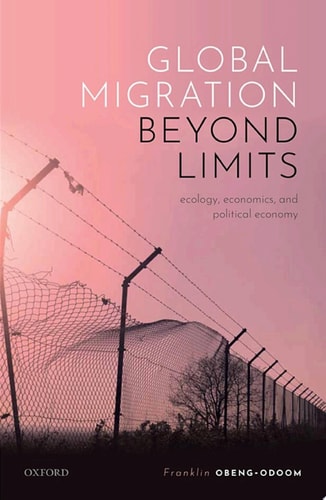
Global Migration beyond Limits: Ecology, Economics, and Political Economy
0
0
As an Amazon Associate and affiliate partner, Menrva Books earns from qualifying purchases. Learn more
Author Description
Global Migration beyond Limits takes a critical approach to mainstream economic accounts of migration, environment, and inequality. Drawing on a range of case studies from Africa, the Middle East, Asia, Australia, Europe, and the Americas, Obeng-Odoom argues that much of the crisis of migration can be understood as a reflection of cumulative stratification at different scales in the global system, though the form of migration is conditioned by more than economic forces. Examining the experiences of migrant farmers, street workers, refugees, international students, and many more, this book shows that the so-called migration crisis is an expression of a political-economic system in which socially created value is privately appropriated as rents by a privileged few who use institutions such as land and property rights, race, ethnicity, class, and gender to keep others in their place.
Menrva's Summary
THE THESIS
This book investigates whether the contemporary global migration crisis is primarily a result of economic necessity or a manifestation of systemic political-economic stratification. Franklin Obeng-Odoom, a scholar in political economy, utilizes a multidisciplinary framework to challenge mainstream economic narratives. He argues that migration patterns are driven by the private appropriation of socially created value, facilitated by institutional structures such as property rights, race, and class, rather than simple market forces.
THE SCOPE MAP
What You Will Find
- Analysis of migration patterns across Africa, the Middle East, Asia, Australia, Europe, and the Americas
- A critique of rent-seeking behavior in the context of global land and property rights
- Examination of diverse migrant experiences including farmers, street workers, refugees, and international students
Scope Limits
- The text does not provide a comprehensive policy manual for individual nation-state border management
- It avoids purely quantitative demographic forecasting in favor of qualitative political-economic analysis
THE AUTHORITY PERSPECTIVE
Experts in political economy and migration studies identify this work as a rigorous challenge to neoclassical economic perspectives on human mobility. Readers frequently note the dense, critical nature of the prose, which demands familiarity with institutional economics and social theory.
Page Count:
532
Publication Date:
2021-01-01
Publisher:
OUP Oxford
ISBN-10:
0192637029
ISBN-13:
9780192637024
Economics
Migration Studies
Sociology
Community Tags
Similar Books