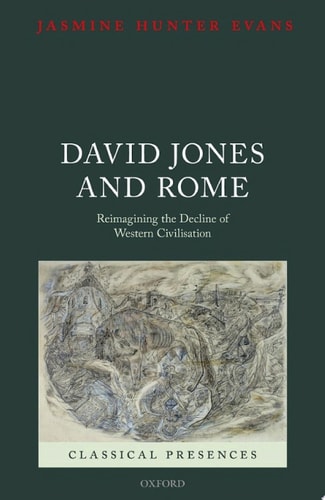
David Jones and Rome: Reimagining the Decline of Western Civilisation
0
0
As an Amazon Associate and affiliate partner, Menrva Books earns from qualifying purchases. Learn more
Author Description
This interdisciplinary and archival study explores the reception of ancient Rome in the artistic, literary, and philosophical works of David Jones (1895-1974)—the Anglo-Welsh, Roman Catholic, First World War veteran. For Jones, the twentieth century was a period of crisis, an age of conflict, disillusionment and cultural decay, all of which he saw as evidence of the decline of Western civilisation. Across his lifetime, Jones would create a dynamic vision of ancient Rome in an attempt both to understand and to challenge this situation. His reimagining of Rome was not founded on a classical education. Instead, it was fashioned from his lived experience, extensive reading, and—most importantly—his engagement with four areas of contemporary discourse that were themselves built upon intricate and conflicting representations of Rome: British political rhetoric, cyclical history, the Catholic cultural revival, and the Welsh nationalist movement. Tracing Jones's developing approach to Rome across these contexts can provide a way into his art and thought. Whether in his poetic fragments, watercolours, essays, letters, marginalia or unique painted inscriptions, Jones strove to question, complicate and remake Rome's relationship with modernity. In this way, Rome appears in Jones's works both as a symbol of transhistorical imperialism, totalitarianism, and the mechanisation of life, and simultaneously as the cultural and religious progenitor of the West, and in particular, of Wales, with which artists must creatively reconnect if decline was to be avoided.
Menrva's Summary
THE THESIS
This study investigates how the Anglo-Welsh artist and writer David Jones utilized the imagery and history of ancient Rome to interpret the cultural and political crises of the twentieth century. Jasmine Hunter Evans, a scholar of modern literature and classical reception, examines how Jones synthesized his experiences as a First World War veteran with his Catholic faith and Welsh identity to construct a unique, non-academic vision of the Roman past. The book argues that Jones viewed Rome as a multifaceted symbol, simultaneously representing the dangers of imperial mechanization and the foundational cultural heritage necessary for Western renewal.
THE SCOPE MAP
What You Will Find
- Analysis of David Jones's diverse creative output, including poetry, watercolours, essays, and painted inscriptions.
- Examination of four primary discursive contexts: British political rhetoric, cyclical history, the Catholic cultural revival, and Welsh nationalism.
- A study of the intersection between modernism and classical reception in the early-to-mid twentieth century.
Scope Limits
- The text does not provide a comprehensive biography of David Jones, focusing instead on his specific engagement with Roman history.
- The analysis is restricted to Jones's personal and artistic interpretation of Rome rather than a general history of Roman influence on modern art.
THE AUTHORITY PERSPECTIVE
Scholars in the field of classical reception recognize this work as a significant contribution to understanding the intersection of modernism and antiquity. Readers frequently note the academic density of the prose, which provides a rigorous framework for interpreting Jones's complex artistic and literary output.
Page Count:
420
Publication Date:
2022-01-01
Publisher:
OUP Oxford
ISBN-10:
0192638599
ISBN-13:
9780192638595
History
Biography
English
English literature
Literary Criticism
Art History
English & College Success