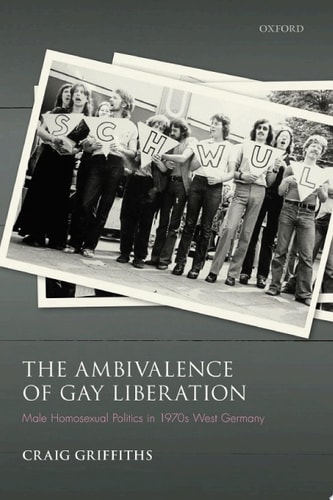
The Ambivalence of Gay Liberation: Male Homosexual Politics in 1970s West Germany
0
0
As an Amazon Associate and affiliate partner, Menrva Books earns from qualifying purchases. Learn more
Author Description
The Ambivalence of Gay Liberation explores ways of thinking, feeling, and talking about being gay in the 1970s, an influential decade sandwiched between the partial decriminalisation of male homosexuality in 1969, and the arrival of the HIV/AIDS crisis in the early 1980s. Moving beyond divided Cold War Berlin, it also focuses on lesser-known cities, such as Aachen, Cologne, Frankfurt, Münster, and Stuttgart, to name just a few of the 53 localities that were home to a gay group by the end of the 1970s. These groups were important, and this book tells their story. In 1970s West Germany gay liberation did not take place only in activist meetings, universities, and on street demonstrations, but also on television, in magazine editorial offices, ordinary homes, bedrooms, and beyond. In considering all these spaces and individuals, this book provides a more complex account than previous histories, which have tended to focus only on a social movement and only on the idea of 'gay pride'. By drawing attention to ambivalence, this book shows that gay liberation was never only about pride, but also about shame; characterized not only by hope, but also by fear; and driven forward not just by the pushes of confrontation, but also by the pulls of conformism. Ranging from the painstaking emergence of the gay press to the first representation of homosexuality on television, from debates over the sexual legacy of 1968 and the student movement to the memory of Nazi persecution, The Ambivalence of Gay Liberation is the first English-language book to tell the story of male homosexual politics in 1970s West Germany. In doing so, this book changes the way we think about modern queer history.
Menrva's Summary
THE THESIS
This book investigates the complex, often contradictory nature of gay liberation in 1970s West Germany, challenging the singular narrative of 'gay pride' as the movement's sole driver. Author Craig Griffiths, a historian specializing in modern German history, utilizes a wide array of archival materials and local histories to argue that the movement was defined as much by shame, fear, and conformism as it was by hope and confrontation. By examining the period between the 1969 decriminalization and the onset of the HIV/AIDS crisis, Griffiths provides a nuanced framework for understanding how homosexual identity was negotiated in both public and private spheres.
THE SCOPE MAP
What You Will Find
- Analysis of 53 distinct localities across West Germany, including Aachen, Cologne, and Frankfurt.
- Examination of media representations, including the emergence of the gay press and television portrayals.
- Historical context regarding the legacy of the 1968 student movement and the memory of Nazi-era persecution.
- Primary source research from activist meetings, editorial offices, and personal accounts.
Scope Limits
- The study focuses specifically on male homosexual politics and does not provide an exhaustive history of lesbian or transgender activism in the same period.
- The analysis concludes at the early 1980s, excluding the subsequent impact of the HIV/AIDS crisis on political organization.
THE AUTHORITY PERSPECTIVE
Scholars and historians recognize this work as a significant contribution to queer history, particularly for its focus on regional diversity beyond the major metropolitan centers. Readers frequently note the academic density of the prose and the author's meticulous attention to the internal tensions within the West German gay movement.
Page Count:
252
Publication Date:
2021-01-01
Publisher:
OUP Oxford
ISBN-10:
0192639781
ISBN-13:
9780192639783
History
German history
LGBTQ Studies
Modern History
Sociology