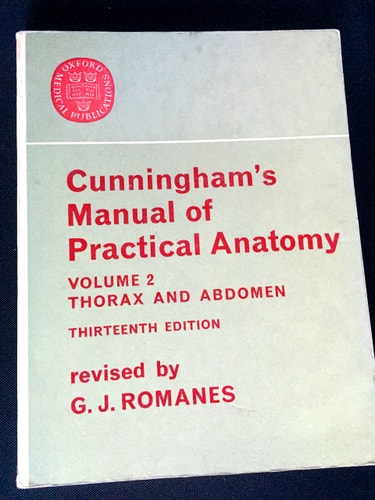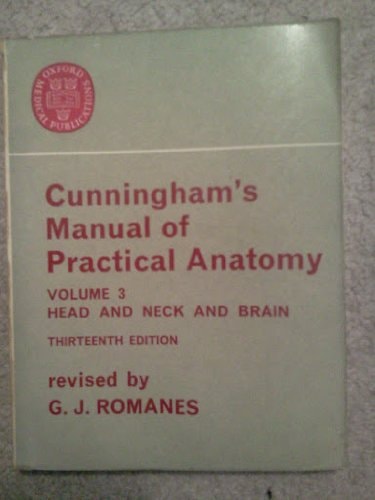
Cunningham's Manual of Practical Anatomy, Vol. 3: Head and Neck and Brain
0
0
As an Amazon Associate and affiliate partner, Menrva Books earns from qualifying purchases. Learn more
Author Description
This historic book may have numerous typos and missing text. Purchasers can usually download a free scanned copy of the original book (without typos) from the publisher. Not indexed. Not illustrated. 1920 edition. Excerpt:...in maintaining the curvatures of the vertebral column; they also give valuable aid to the muscles in restoring the vertebral column to its original position after it has been bent in a ventral direction. The interspinous ligaments are most strongly developed in the lumbar region, where they fill up the intervals between the adjacent margins of contiguous spinous processes. In the thoracic region, and more so in the neck, they are very weak. The supraspinous ligaments are thickened bands which connect the summits of the spinous processes. In the neck they are replaced by the ligamentum nuchae (p. 67). The z'ntertran.v0erse lzlgamenls are feebly marked in the cervical region and extend chiefly between the anterior bars of the transverse processes. Articulations of the Epistropheus, Atlas, and Occipital Bone.--The articulations which exist between the atlas and the occipital bone and the atlas and the epistropheus all belong to the diarthrodial class. Between the atlas and epistropheus (O.T. axis) there are three such joints--viz., a pair between the opposed articular processes, and a third between the anterior face of the dens and the posterior face of the anterior arch of the atlas. Between the atlas and occipital bone there is a pair of joints--viz., between the occipital condyles and the elliptical cavities upon the upper aspects of the lateral masses of the atlas. In addition, the epistropheus is attached to the occipital bone by ligaments. The ligaments connecting the three bones together may be divided into three main groups, as follows:--Anterior longitudinal. Ligamenta flava. Li aments connecting atlas Capsular'--‘ g Transverse portion of cruciate hgament with epistropheus’ ' ' ' with inferior crus. Accessory ligaments...
Menrva's Summary
THE THESIS
This volume investigates the structural anatomy of the human head, neck, and brain through a systematic, practical approach. Daniel John Cunningham, a prominent anatomist, provides a rigorous framework for medical students and practitioners to understand the complex spatial relationships and articulations of the cranial and cervical regions. The text relies on detailed descriptive analysis and classical anatomical observation to guide the reader through the physical components of the human body.
THE SCOPE MAP
What You Will Find
- Detailed descriptions of the articulations of the epistropheus, atlas, and occipital bone
- Analysis of ligamentous structures including interspinous and supraspinous ligaments
- Systematic breakdown of the cervical and cranial skeletal systems
Scope Limits
- This specific edition lacks modern illustrations and indices
- The text reflects anatomical knowledge and terminology as of the early 20th century
THE AUTHORITY PERSPECTIVE
Experts recognize this work as a foundational historical text in the field of medical education. Readers frequently note the high density of the prose and the necessity of consulting updated anatomical atlases alongside this volume for visual clarity.
Page Count:
318
Publication Date:
1966-01-01
Publisher:
OXFORD UNIVERSITY PRESS
ISBN-10:
0192631209
ISBN-13:
9780192631206
Science
textbook
Reference
Anatomy
Medical
Community Tags
Similar Books