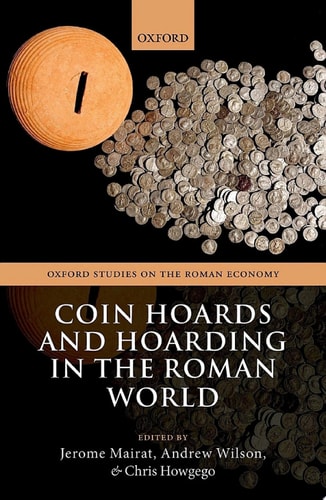
Coin Hoards and Hoarding in the Roman World
0
0
As an Amazon Associate and affiliate partner, Menrva Books earns from qualifying purchases. Learn more
Author Description
Coin Hoards and Hoarding in the Roman World presents fourteen chapters from an interdisciplinary group of Roman numismatists, historians, and archaeologists, discussing coin hoarding in the Roman Empire from c. 30 BC to AD 400. The book illustrates the range of research themes being addressed by those connected with the Coin Hoards of the Roman Empire Project, which is creating a database of all known Roman coin hoards from Augustus to AD 400. The volume also reflects the range of the Project's collaborations, with chapters on the use of hoard data to address methodological considerations or monetary history, and coverage of hoards from the west, centre, and east of the Roman Empire, essential to assess methodological issues and interpretations in as broad a context as possible. Chapters on methodology and metrology introduce statistical tools for analysing patterns of hoarding, explore the relationships between monetary reforms and hoarding practices, and address the question of value, emphasizing the need to consider the whole range of precious metal artefacts hoarded. Several chapters present regional studies, from Britain to Egypt, conveying the diversity of hoarding practices across the Empire, the differing methodological challenges they face, and the variety of topics they illuminate. The final group of chapters examines the evidence of hoarding for how long coins stayed in circulation, illustrating the importance of hoard evidence as a control on the interpretation of single coin finds, the continued circulation of Republican coins under the Empire, and the end of the small change economy in Northern Gaul.
Menrva's Summary
THE THESIS
This volume investigates the motivations, patterns, and economic implications of coin hoarding practices across the Roman Empire from 30 BC to AD 400. Jerome Mairat and a collective of numismatists, historians, and archaeologists utilize data from the Coin Hoards of the Roman Empire Project to establish a rigorous framework for interpreting buried currency. By synthesizing regional case studies with statistical methodology, the authors argue that hoard evidence serves as a critical control for understanding monetary circulation and economic shifts within the imperial structure.
THE SCOPE MAP
What You Will Find
- Statistical tools for analyzing hoarding patterns and metrology
- Comparative regional studies spanning from Britain to Egypt
- Analysis of the relationship between monetary reforms and hoarding behavior
- Examination of precious metal artifacts beyond coinage
Scope Limits
- The study is strictly confined to the period between 30 BC and AD 400
- It does not provide an exhaustive catalog of every known hoard, but rather focuses on methodological applications
THE AUTHORITY PERSPECTIVE
Experts recognize this volume as a significant contribution to the Coin Hoards of the Roman Empire Project, providing a standardized methodology for numismatic research. Readers frequently note the academic density of the prose, which is intended for scholars and advanced students of Roman economic history.
Page Count:
368
Publication Date:
2022-01-01
Publisher:
OUP Oxford
ISBN-10:
0192636243
ISBN-13:
9780192636249
History
Economics
Ancient History
Archaeology
Academic
Numismatics
Roman Empire
Community Tags
Similar Books