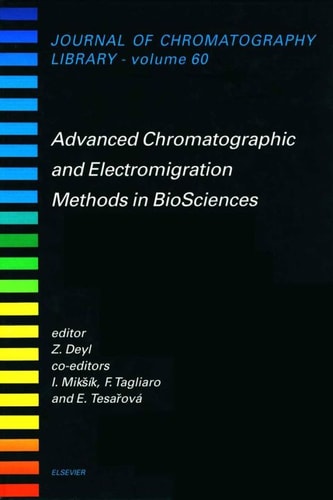
Advanced Chromatographic and Electromigration Methods in BioSciences
0
0
As an Amazon Associate and affiliate partner, Menrva Books earns from qualifying purchases. Learn more
Author Description
This book deals with chromatographic and electrophoretic methods applied for the separation (quantitation and identification) of biologically relevant compounds. It is assumed that the potential reader is familiar with the basics of chromatographic and electromigration methods. Individual separation modes are dealt with to an extent which follows their applicability for biomedical purposes: liquid chromatography and electromigration methods are therefore highlighted. Each chapter is completed with a list of recent literature covering the 1987-1997 period, which can be used for further guidance of the reader in his/her own field. The chapters have been written by specialists in a particular area and with an emphasis on applications to the biomedical field. This implies that theoretical and instrumental aspects are kept to a minimum which allows the reader to understand the text. Considerable attention is paid to method selection, detection and derivatization procedures and troubleshooting. The majority of examples given represent the analyses of typical naturally-occurring mixtures. Adequate attention is paid to the role of the biological matrix and sample pretreatment, and special attention is given to forensic, toxicological and clinical applications. The book is completed with an extensive Index of Compounds Separated.
Menrva's Summary
THE THESIS
This book investigates the application of chromatographic and electrophoretic methods for the separation, quantitation, and identification of biologically relevant compounds. It assumes a reader familiar with basic chromatographic and electromigration techniques, focusing on their applicability in biomedical fields. Liquid chromatography and electromigration methods are highlighted, with each chapter written by specialists and emphasizing practical applications over theoretical or instrumental details. The text provides guidance on method selection, detection, derivatization, and troubleshooting, using examples from naturally occurring mixtures and addressing the role of biological matrices and sample pretreatment.
THE SCOPE MAP
- Detailed coverage of liquid chromatography and electromigration methods for biological compound analysis.
- Emphasis on practical applications in forensic, toxicological, and clinical settings.
- Guidance on method selection, detection, derivatization, and troubleshooting.
- Examples drawn from the analysis of naturally occurring mixtures.
- Discussion of the biological matrix and sample pretreatment procedures.
- Literature references covering the period 1987-1997 for further study.
- An extensive Index of Compounds Separated.
THE AUTHORITY PERSPECTIVE
The book is structured to provide practical guidance for specialists in biomedical fields, focusing on applied techniques rather than extensive theory. Its coverage of specific separation methods, coupled with recent literature references from the late 1990s, suggests a resource aimed at researchers and practitioners needing to understand and implement these techniques. The inclusion of troubleshooting and method selection advice indicates a focus on the practical challenges faced in laboratory analysis. The emphasis on real-world applications, particularly in forensic, toxicological, and clinical contexts, positions it as a valuable reference for those working directly with biological samples.
Page Count:
1125
Publication Date:
1998-01-01
Publisher:
Elsevier S & T
ISBN-10:
0444825940
ISBN-13:
9780444825940
Science
Non-Fiction
Biotechnology
Biochemistry
Analytical Chemistry
Forensic Science
Toxicology
Community Tags
Similar Books