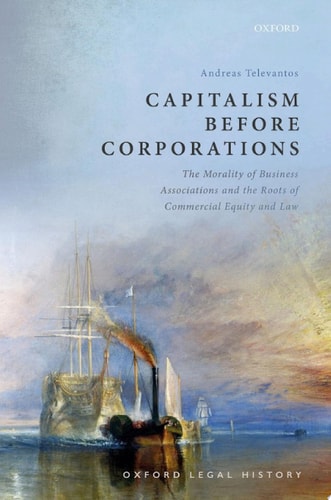
Capitalism Before Corporations: The Morality of Business Associations and the Roots of Commercial Equity and Law
0
0
As an Amazon Associate and affiliate partner, Menrva Books earns from qualifying purchases. Learn more
Author Description
To what extent did English law facilitate trade before the advent of general incorporation and modern securities law? This is the question at the heart of Capitalism before Corporations. It examines the extent to which legal institutions of the Regency period, especially Lord Eldon's Chancellorship, were sympathetic to the needs of merchants and willing to accommodate their changing practices and demands within established legal doctrinal frameworks and contemporary political economic thought. In so doing, this book probes at the heart of modern debates about equity, trusts, insolvency, and the justifiability of corporate privileges. Corporations are an integral part of modern life. We bank with corporations, we usually buy our groceries from them, and they provide us with most news and media. We take it for granted too that most large-scale business, and even much small-scale business, is carried out by corporations. Things were not always so. Televantos considers the Bubble Act of 1720, which criminalised the forming of corporations without a Royal Charter or Act of Parliament, its repeal in 1825, and the subsequent impact. Much of the modernisation of Britain's industry therefore took place before general incorporation was allowed. Unaided by statute, traders had to create business organisations using the basic building blocks of private law: trusts, partnership, and agency.
Menrva's Summary
THE THESIS
This book investigates the extent to which English legal institutions facilitated trade and commercial development during the Regency period prior to the widespread adoption of general incorporation. Professor Andreas Televantos utilizes historical legal doctrine, political economic theory, and the specific judicial record of Lord Eldon's Chancellorship to argue that merchants successfully adapted private law frameworks to meet their needs. By examining the transition between the Bubble Act of 1720 and the eventual rise of modern corporate law, the author demonstrates how foundational legal tools like trusts and partnerships enabled industrial growth without statutory corporate privileges.
THE SCOPE MAP
What You Will Find
- Analysis of the Bubble Act of 1720 and its 1825 repeal
- Examination of Regency-era legal institutions and judicial practices
- Application of private law concepts including trusts, agency, and partnership
- Historical context of British industrial modernization
Scope Limits
- Does not provide a comprehensive history of modern securities law
- Focuses primarily on the English legal system rather than comparative international law
THE AUTHORITY PERSPECTIVE
Legal scholars and historians identify this work as a significant contribution to the understanding of pre-corporate commercial organization. Readers frequently note the academic density of the prose, which provides a rigorous examination of doctrinal legal history for specialists in the field.
Page Count:
224
Publication Date:
2020-01-01
Publisher:
OUP Oxford
ISBN-10:
0192643177
ISBN-13:
9780192643179
Non-Fiction
Economic History
Professional Career & Trade
Great Britain
Business Law
Corporate Law
Legal History
British History
Community Tags
Similar Books