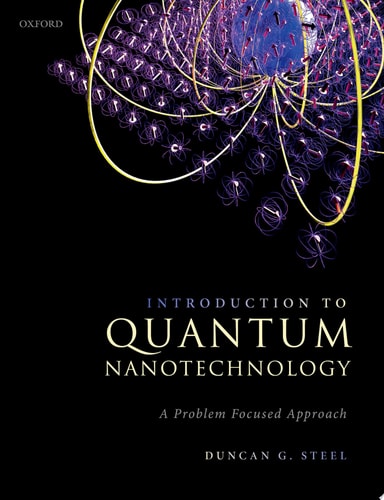
Introduction to Quantum Nanotechnology: A Problem Focused Approach
0
0
As an Amazon Associate and affiliate partner, Menrva Books earns from qualifying purchases. Learn more
Author Description
Quantum is rapidly emerging as a game-changer in technology. The end of Moore's Law for exponential growth is rapidly approaching and engineers and physicist alike are looking at moving past the classical limitations of modern technology and are exploring the new opportunities that quantum behaviour creates in sensing, metrology, communications and information processing. This book serves as introduction to quantum theory with emphasis on dynamical behaviour and applications of quantum mechanics, with minimal discussion of formalism. The goal is to help students begin to learn the tools for a quantum toolbox they will need to work in this area. It is aimed at upper level undergraduates and first year graduate students and assumes the reader has not had any training in quantum mechanics beyond what might be encountered in two semesters of introductory physics. The language of quantum is mathematics and builds on what is covered in typically the first two years. The first six chapters introduce Schrödinger's equation and develop the quantized description of common systems that exist in real space like a vibrator, nano-particles, atoms, crystals, etc. Beginning in Ch. 7 and for the remaining nine chapters, the focus is primarily on dynamical behaviour and how to think about real quantum systems. Spin, the quantized electromagnetic field, dissipation, loss and spontaneous emission, are discussed as well as quantum optics and the operator equations for common two-state systems such as the quantum flip flop and the density matrix equations. The book is structured so that a two semester course sequence is possible or a single semester course with options discussed in the preface to set different learning objectives. Even a one semester course based on this text covers much more material than a typical upper quantum course for undergraduates in physics, but at the expense of more detailed discussions about solutions to various differential equations such as for angular mome
Menrva's Summary
THE THESIS
This book investigates how quantum mechanical principles can be applied to solve engineering problems as traditional semiconductor scaling reaches its physical limits. Duncan G. Steel, drawing on his background in physics and engineering, provides a framework that prioritizes dynamical behavior and practical application over abstract formalism. The text is designed to equip upper-level undergraduates and early-stage graduate students with a functional quantum toolbox for modern technological development.
THE SCOPE MAP
What You Will Find
- Mathematical foundations for quantum systems including Schrödinger's equation.
- Analysis of real-space systems such as nano-particles, atoms, and crystals.
- Advanced topics including spin, quantized electromagnetic fields, dissipation, and density matrix equations.
Scope Limits
- The text intentionally minimizes deep dives into the formal mathematical proofs of differential equations.
- It assumes the reader has completed two semesters of introductory physics.
THE AUTHORITY PERSPECTIVE
Experts identify this text as a practical bridge between theoretical physics and applied engineering. Readers frequently note that the problem-focused approach makes complex quantum dynamics accessible for students transitioning from introductory coursework to specialized research.
Page Count:
400
Publication Date:
2021-01-01
Publisher:
OUP Oxford
ISBN-10:
0192647970
ISBN-13:
9780192647979
Science
textbook
Construction
Electrical
Nanotechnology
Engineering
Trades & Technology
Technology
Physics
Community Tags
Similar Books