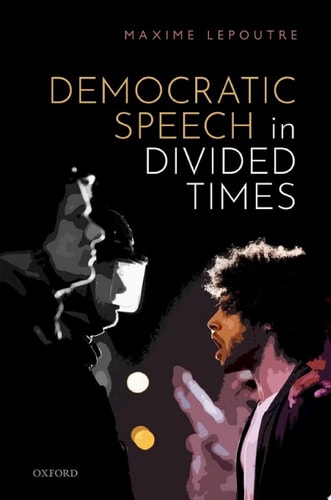
Democratic Speech in Divided Times
0
0
As an Amazon Associate and affiliate partner, Menrva Books earns from qualifying purchases. Learn more
Author Description
In an ideal democracy, people from all walks of life would come together to talk meaningfully and respectfully about politics. But we do not live in an ideal democracy. In contemporary democracies, which are marked by deep social divisions, different groups for the most part avoid talking to each other. And when they do talk to each other, their speech often seems to be little more than a vehicle for rage, hatred, and deception. Democratic Speech in Divided Times argues that we should nevertheless not give up on the ideal of democratic public speech. Drawing on the resources of political theory, epistemology, and philosophy of language, this book develops a sustained account of the norms that should govern public discourse in deeply divided circumstances. Should we try to find common ground when we talk to our political opponents, even though they seem unreasonable? Should we refrain from expressing anger, if we want to get things done? How can we use our speech to fight hate speech and disinformation? And is it even possible to speak to 'the other side,' in settings where different groups dislike one another, live apart from one another, and don't know much about one another? By tackling these questions, Lepoutre demonstrates that, when governed by the right set of norms, public speech can be a powerful force for good even amidst profound social divisions.
Menrva's Summary
THE THESIS
This book investigates how democratic public discourse can remain functional and constructive within societies characterized by deep social polarization and animosity. Maxime Lepoutre, a scholar in political theory, synthesizes insights from epistemology and the philosophy of language to construct a normative framework for political communication. He argues that despite the prevalence of rage and deception in modern discourse, specific communicative norms can preserve the potential for public speech to serve as a positive force in divided environments.
THE SCOPE MAP
What You Will Find
- Normative guidelines for engaging with political opponents perceived as unreasonable
- Analysis of the role of anger in political efficacy
- Strategies for addressing hate speech and disinformation through discourse
- Philosophical examination of cross-group communication in segregated settings
Scope Limits
- The text does not provide a comprehensive history of democratic institutions
- It does not offer empirical sociological data on specific contemporary political movements
THE AUTHORITY PERSPECTIVE
Experts in political theory identify this work as a rigorous contribution to the ethics of public discourse. Readers frequently note the academic density of the prose, which is well-suited for scholars and students of political philosophy.
Page Count:
277
Publication Date:
2021-01-01
Publisher:
OUP Oxford
ISBN-10:
0192642448
ISBN-13:
9780192642448
Discussion
Sociology
Freedom of speech
Philosophy of
Epistemology
Communication in politics
Hate speech
Political Philosophy
Democracy
Community Tags
Similar Books