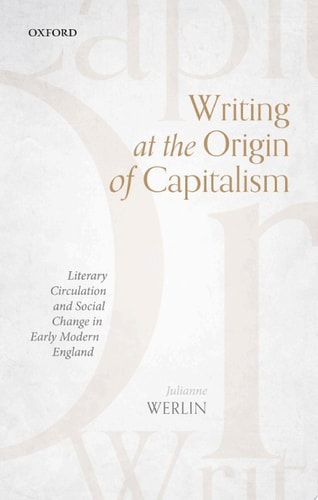
Writing at the Origin of Capitalism: Literary Circulation and Social Change in Early Modern England
0
0
As an Amazon Associate and affiliate partner, Menrva Books earns from qualifying purchases. Learn more
Author Description
In the late sixteenth through seventeenth centuries, England simultaneously developed a national market and a national literary culture. Writing at the Origin of Capitalism describes how economic change in early modern England created new patterns of textual production and circulation with lasting consequences for English literature. Synthesizing research in book and media history, including investigations of manuscript and print, with Marxist historical theory, this volume demonstrates that England's transition to capitalism had a decisive impact on techniques of writing, rates of literacy, and modes of reception, and, in turn, on the form and style of texts. Individual chapters discuss the impact of market integration on linguistic standardization and the rise of a uniform English prose; the growth of a popular literary market alongside a national market in cheap commodities; and the decline of literary patronage with the monarchy's loosening grip on trade regulation, among other subjects. Peddlers' routes and price integration, monopoly licenses and bills of exchange, all prove vital for understanding early modern English writing. Each chapter reveals how books and documents were embedded in wider economic processes, and as a result, how the origin of capitalism constituted a revolutionary event in the history of English literature.
Menrva's Summary
THE THESIS
This volume investigates how the transition to capitalism in early modern England fundamentally reshaped the production, circulation, and stylistic development of English literature. Julianne Werlin, a scholar of early modern literature, synthesizes Marxist historical theory with empirical research in book and media history. She argues that the emergence of a national market and the integration of trade networks directly influenced linguistic standardization, the decline of traditional patronage, and the rise of a commercial literary culture.
THE SCOPE MAP
What You Will Find
- Analysis of the correlation between market integration and the standardization of English prose.
- Examination of the shift from monarchical patronage to commercial literary markets.
- Investigation into the role of economic infrastructure, such as peddlers' routes and monopoly licenses, in textual distribution.
- Theoretical framework connecting Marxist economic history with the evolution of literary forms.
Scope Limits
- The study focuses specifically on the sixteenth and seventeenth centuries in England.
- It does not provide a comprehensive history of all English literary genres, focusing instead on the intersection of economic and textual production.
THE AUTHORITY PERSPECTIVE
Scholars in the field of early modern studies recognize this work as a significant contribution to the materialist history of the book. Readers frequently note the academic density of the prose and the rigorous integration of economic data with literary analysis.
Page Count:
195
Publication Date:
2021-01-01
Publisher:
OUP Oxford
ISBN-10:
0192640755
ISBN-13:
9780192640758
History
Early Modern
Economic History
Marxist Theory
Literary Criticism
English
Manners and customs
Book History
Publishers and publishing
English literature
English & College Success
Community Tags
Similar Books