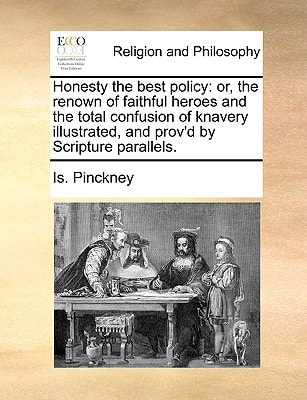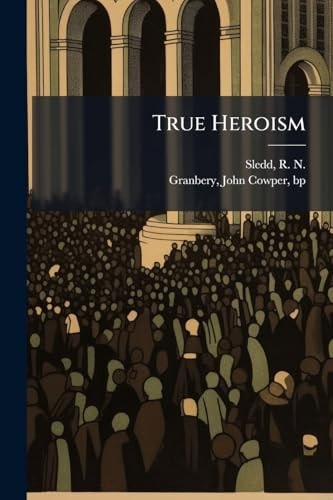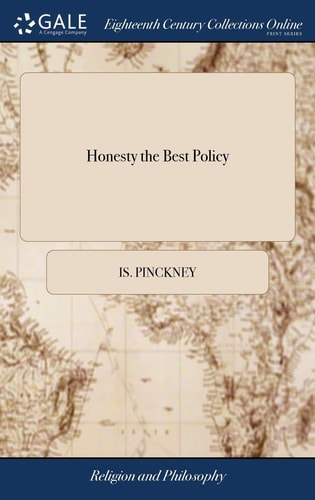
Honesty the Best Policy Or, the Renown of Faithful Heroes and the Total Confusion of Knavery Illustrated, and Prov'd by Scripture Parallels
0
0
As an Amazon Associate and affiliate partner, Menrva Books earns from qualifying purchases. Learn more
Author Description
The 18th century was a wealth of knowledge, exploration and rapidly growing technology and expanding record-keeping made possible by advances in the printing press. In its determination to preserve the century of revolution, Gale initiated a revolution of its own: digitization of epic proportions to preserve these invaluable works in the largest archive of its kind. Now for the first time these high-quality digital copies of original 18th century manuscripts are available in print, making them highly accessible to libraries, undergraduate students, and independent scholars. The Age of Enlightenment profoundly enriched religious and philosophical understanding and continues to influence present-day thinking. Works collected here include masterpieces by David Hume, Immanuel Kant, and Jean-Jacques Rousseau, as well as religious sermons and moral debates on the issues of the day, such as the slave trade. The Age of Reason saw conflict between Protestantism and Catholicism transformed into one between faith and logic -- a debate that continues in the twenty-first century. ++++ The below data was compiled from various identification fields in the bibliographic record of this title. This data is provided as an additional tool in helping to insure edition identification: ++++ British Library N017519 Dedication and preface signed: Is. Pinckney. London: printed, and sold by R. Ford; and S. Sheaf, 1716. [10],67, [3]p.; 8°
Menrva's Summary
THE THESIS
This work investigates the moral imperative of honesty and contrasts it with the inevitable downfall of deceit, drawing upon scriptural examples to illustrate its central argument. The author, Is. Pinckney, presents a moral treatise that likely explores the virtues of integrity and the consequences of dishonesty, using biblical parallels to reinforce these lessons. The text is framed within the context of 18th-century religious and philosophical discourse, a period marked by significant intellectual and technological advancements.
THE SCOPE MAP
- Exploration of the virtue of honesty and its scriptural basis.
- Examination of the confusion and negative outcomes associated with knavery (deceit/dishonesty).
- Use of biblical parallels to support moral arguments.
- Contextualization within 18th-century religious and philosophical thought.
- Discussion of moral debates relevant to the period.
THE AUTHORITY PERSPECTIVE
This 1716 publication by Is. Pinckney, 'Honesty the Best Policy', appears to be a moralistic work rooted in religious and philosophical discourse of the early 18th century. The text likely served as a didactic tool, using scriptural examples to advocate for honesty and condemn deceit. Its inclusion in digital archives of 18th-century manuscripts suggests its value as a historical document reflecting the moral and religious concerns of the Age of Enlightenment. The work's focus on virtue and vice aligns with the broader intellectual currents of its time, contributing to the ongoing dialogue on ethics and human behavior.
Page Count:
84
Publication Date:
2018-04-22
Publisher:
Creative Media Partners, LLC
ISBN-10:
138515182X
ISBN-13:
9781385151822
Non-Fiction
Philosophy
Religion
Christian ethics
Virtue
Sermons
Vice
Morality
Community Tags
Similar Books