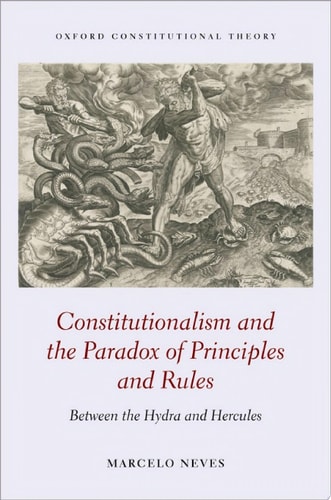
Constitutionalism and the Paradox of Principles and Rules: Between the Hydra and Hercules
0
0
As an Amazon Associate and affiliate partner, Menrva Books earns from qualifying purchases. Learn more
Author Description
This title offers a unique approach to constitutionalism, focusing on the paradoxical relationship between principles and rules from the perspective of systems theory. It presents a critical counterpoint to Ronald Dworkin's principle-based theory, and in particular to Robert Alexy's idea of optimizing balancing. Instead of ceding to the compulsion of an optimizing balancing, it suggests the possibility of a comparative or at least 'satisficing' balancing, considering the precariousness of legal rationality. The book also reverses Dworkin's metaphor, associating rules with Hercules and principles with the Hydra. It takes constitutional principles seriously, criticizing the abuse of principles by the legal and constitutional doctrine and practice, and pointing out their relationship of complementarity and tension with rules. Finally, it offers an alternative model to the recent legal and constitutional theory on the basis of certain assumptions of the systems theory. It deals especially with the paradox of the circular and reflexive relationship between constitutional principles and rules: the former refers primarily to the openness and adequacy of legal system to society and thus to substantive argumentation; the second refers primarily to the closure and consistency of legal system and thus to formal argumentation.
Menrva's Summary
THE THESIS
How can constitutional systems navigate the inherent tension between the openness of principles and the formal closure of rules without succumbing to the pitfalls of over-balancing? Marcelo Neves, a scholar of legal systems theory, challenges the prevailing reliance on principle-based optimization models, such as those proposed by Robert Alexy and Ronald Dworkin. By applying a systems-theory framework, Neves argues that the current legal doctrine often abuses principles, leading to a precarious form of rationality that requires a more nuanced, 'satisficing' approach to legal interpretation.
THE SCOPE MAP
What You Will Find
- A critical analysis of the reflexive relationship between constitutional principles and legal rules.
- An alternative model for constitutional adjudication based on systems theory.
- A comparative critique of Dworkin’s Hercules metaphor versus the Hydra-like nature of principles.
Scope Limits
- The text does not provide a comprehensive historical survey of global constitutionalism.
- It does not offer a practical manual for trial-level litigation, focusing instead on high-level theoretical jurisprudence.
THE AUTHORITY PERSPECTIVE
Legal scholars and theorists recognize this work as a sophisticated intervention in contemporary constitutional discourse, particularly for its critique of balancing methodologies. Readers frequently note the academic density of the prose, which requires a strong background in systems theory and jurisprudence to fully synthesize the author's arguments.
Page Count:
212
Publication Date:
2021-01-01
Publisher:
OUP Oxford
ISBN-10:
0192653954
ISBN-13:
9780192653956
Constitutional Law
Professional Career & Trade
Law
Law Philosophy
Systems Theory
Legal Theory
Community Tags
Similar Books