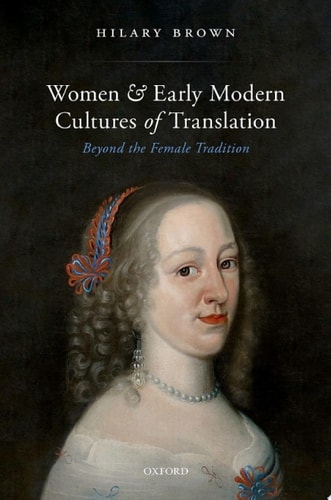
Women and Early Modern Cultures of Translation: Beyond the Female Tradition
0
0
As an Amazon Associate and affiliate partner, Menrva Books earns from qualifying purchases. Learn more
Author Description
Women and Early Modern Cultures of Translation: Beyond the Female Tradition is a major new intervention in research on early modern translation and will be an essential point of reference for anyone interested in the history of women translators. Research on women translators has often focused on early modern England; the example of early modern England has been taken as the norm for the rest of the continent and has shaped research on gender and translation more generally. This book brings a new European perspective to the field by introducing the case of Germany. It draws attention to forty women who can be identified as translators in sixteenth- and seventeenth-century Germany and shows how their work does not fit easily into traditional narratives about marginalization and subversiveness. The study uses the example of Germany to argue against reading the work of translating women primarily through the lens of gender and to challenge claims about the existence of a female translation tradition which transcends the boundaries of time and place. Broadening our perspective to include Germany provides a more nuanced and informed account of the position of women within European translation cultures and forces us to rethink gender as a category of analysis in translation history. The book makes the case for a new 'woman-interrogated' approach to translation history (to borrow a concept from Carol Maier) and as such it will provide a blueprint for future work in the area.
Menrva's Summary
THE THESIS
This book investigates whether the work of early modern female translators should be categorized primarily through the lens of gender or a universal female tradition. Hilary Brown, a scholar of early modern German culture, challenges the prevailing academic focus on English women translators by introducing a comprehensive study of forty German women active in the sixteenth and seventeenth centuries. She argues that these translators do not conform to traditional narratives of marginalization and proposes a new 'woman-interrogated' methodology for analyzing translation history.
THE SCOPE MAP
What You Will Find
- A detailed analysis of forty female translators active in sixteenth- and seventeenth-century Germany.
- A critical evaluation of the 'female translation tradition' as a historical construct.
- A proposed 'woman-interrogated' framework for future translation history research.
Scope Limits
- The study does not provide a comprehensive survey of all European regions, focusing instead on the German case as a counterpoint to English-centric research.
THE AUTHORITY PERSPECTIVE
Scholars in the field of translation history recognize this work as a significant intervention that expands the geographical and theoretical boundaries of gender-focused research. Experts highlight the text for its rigorous challenge to established academic norms and its utility as a methodological blueprint for future historical inquiries.
Page Count:
313
Publication Date:
2022-01-01
Publisher:
OUP Oxford
ISBN-10:
019265831X
ISBN-13:
9780192658319
History
Early Modern
European History
Indigenous
Gender Studies
Translation Studies
Translating and interpreting
Literary Criticism
Community Tags
Similar Books