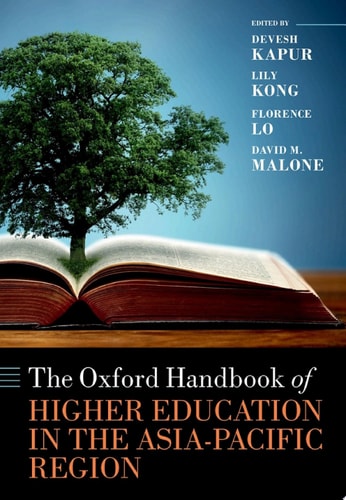
The Oxford Handbook of Higher Education in the Asia-Pacific Region
0
0
As an Amazon Associate and affiliate partner, Menrva Books earns from qualifying purchases. Learn more
Author Description
Since the turn of the millennium it has become clear that the Asia-Pacific Region is, economically, the fastest growing continent in the world, and is likely to remain so for some time despite the setbacks of the COVID-19 pandemic. Asia-Pacific's share of the world's Gross Domestic Product (GDP) doubled from 15 per cent to 30 per cent between 1970 and 2017 and is projected to account for half of global GDP by 2050. With South East and South Asia also growing rapidly, with over half the world's population and three of the world's five largest economies, Asia is soon poised to home half of the world's middle class - a class that is both the driver and the product of higher education. The quality of a country's system of higher education may be seen both as a gauge of its current level of national development as well as of its future economic prospects. It is therefore natural that the putative "Asian Century" should generate interest in the region's higher education systems which, on the one hand, share common characteristics-a fixation with credentials and engineering, high technology (especially among male students), and business degrees-while at the same time are also highly differentiated, not only across countries but also within. As such, a better understanding of higher education achievements, failings, potential, and structural limitations in the Asia-Pacific Region is imperative. This handbook presents a number of significant country case-studies and documents cross-cutting trends relating to, among other things: the trilemma faced by governments juggling competing claims of access, accessible cost, and quality; the balance between teaching and research; the links between labour markets (demand) and higher education (supply); preferred fields of study and their consequences; the rise of the research university in Asia; the lure of institutions of international reputation within the region; new education technologies and their effects; and, trends in governmen
Menrva's Summary
THE THESIS
This volume investigates the structural evolution, economic significance, and diverse challenges facing higher education systems across the Asia-Pacific region. Edited by Lily Kong, Florence Lo, David M. Malone, and Devesh Kapur, the text synthesizes contributions from regional experts to examine how rapid economic growth and demographic shifts influence academic policy. The authors argue that higher education serves as both a primary indicator of national development and a critical engine for future economic sustainability in the context of the projected 'Asian Century.'
THE SCOPE MAP
What You Will Find
- Comparative analysis of higher education systems across diverse Asian nations
- Examination of the trilemma between access, cost, and quality in government policy
- Data on the alignment between labor market demands and academic supply
- Analysis of the rise of research-intensive universities and technological integration
Scope Limits
- Does not provide exhaustive coverage of every individual institution within the region
- Excludes detailed projections for non-academic vocational training sectors
THE AUTHORITY PERSPECTIVE
Experts identify this handbook as a comprehensive reference for policymakers and scholars interested in the intersection of regional development and academic infrastructure. Readers frequently note the academic density of the prose, which provides a rigorous framework for understanding the complexities of the Asian higher education landscape.
Page Count:
1605
Publication Date:
2023-01-01
Publisher:
OUP Oxford
ISBN-10:
0192661035
ISBN-13:
9780192661036
Economics
Public Policy
Sociology
Public Administration
Education
Higher Education
Community Tags
Similar Books