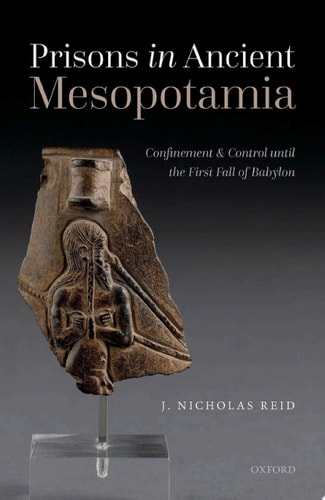
Prisons in Ancient Mesopotamia: Confinement and Control until the First Fall of Babylon
0
0
As an Amazon Associate and affiliate partner, Menrva Books earns from qualifying purchases. Learn more
Author Description
Prisons in Ancient Mesopotamia explores the earliest historical evidence related to imprisonment in the history of the world. While many historical investigations into prisons have revolved around the important question of punishment, this work moves beyond that more narrow approach to consider the multifunctional practices of detaining the body in ancient Iraq. It is the contention of this book that imprisonment arose out of the desire to control and detain the body in relation to labor. The practice of detainment for coercion became adaptable to a variety of circumstances and goals, which shaped the contexts and practices of imprisonment. With time, religious ideology was attached to imprisonment. In one literary text, a prisoner was refined like silver and given new birth in the prison. The misery of imprisonment gave rise to lament through which a criminal could be ritually purified and restored to a right relationship with their personal god. Beyond this literary perspective, this work reconstructs how imprisonment and religious ideology intersected with the judicial process and explores the evidence related to the reasons behind imprisonment, the treatment of prisoners, and the evidence related to the lengths of their stays.
Menrva's Summary
THE THESIS
This work investigates the origins and functional evolution of imprisonment in ancient Mesopotamia, challenging the notion that confinement was solely a punitive measure. Author J. Nicholas Reid utilizes archaeological evidence and cuneiform texts to argue that detention initially emerged as a mechanism for labor control. Over time, this practice integrated religious ideologies, transforming the prison into a space for ritual purification and spiritual restoration alongside its judicial utility.
THE SCOPE MAP
What You Will Find
- Analysis of early historical evidence regarding detention in ancient Iraq.
- Examination of the intersection between judicial processes and religious ideology.
- Reconstructions of prisoner treatment and the duration of confinement.
- Interpretations of literary texts depicting the prison as a site of ritual refinement.
Scope Limits
- The study is geographically restricted to ancient Mesopotamia.
- The chronological scope concludes at the first fall of Babylon.
THE AUTHORITY PERSPECTIVE
Scholars recognize this work as a specialized contribution to the study of ancient legal and social institutions. Readers frequently note the academic density of the prose and the author's meticulous use of primary source material to support his arguments.
Page Count:
214
Publication Date:
2022-01-01
Publisher:
OUP Oxford
ISBN-10:
0192666347
ISBN-13:
9780192666345
History
Near East
Archaeology
Sociology
Mesopotamia
Ancient History
Criminology
Community Tags
Similar Books