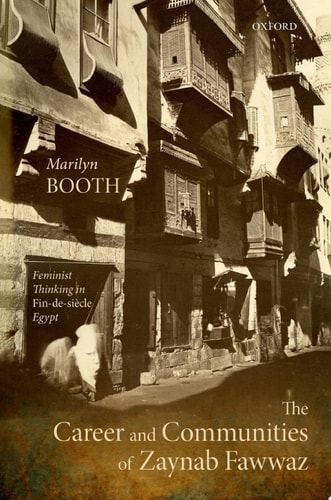
The Career and Communities of Zaynab Fawwaz: Feminist Thinking in Fin-de-siècle Egypt
0
0
As an Amazon Associate and affiliate partner, Menrva Books earns from qualifying purchases. Learn more
Author Description
Zaynab Fawwaz (d. 1914) emerged from an obscure childhood in the Shi'I community of Jabal 'Amil (now Lebanon) to become a recognized writer on women's and girls' aspirations and rights in 1890s Egypt. This book insists on the centrality of gender as a marker of social difference to the Arabic knowledge movement then, or Nahda. Fawwaz published essays and engaged in debates in the Egyptian and Ottoman-Arabic press, published two novels, and the first play known to have been composed in Arabic by a female writer. This book assesses her unusual life history and political engagements--including her work late in life as an informant for the Egyptian khedive. A series of thematically focused chapters takes up her views on social justice, marriage, divorce and polygyny, the 'gender-nature' debate in the context of local understandings of Darwinism, education, and imperialism and Islamophobia, attending also to works by those to whom Fawwaz was responding. Her role in the first Arabic women's magazine, and her contributions to later women's magazines, are part of the story, too. Further chapters consider her uses of history in fiction to criticize patriarchal control of young women's lives, and her play as an intervention into reformist theatre, and the question of women's access to public culture in 1890s Egypt. Questions of desirable masculinities are central to all of these. Fawwaz was also known for her massive biographical dictionary of world women. In that work as in her essays, Fawwaz articulated an ethics of social belonging and sociality predicated on Islamic precepts of gender justice, and critical of the ways male intellectuals had used 'tradition' to silence women and deny their aspirations.
Menrva's Summary
THE THESIS
This book investigates how Zaynab Fawwaz utilized her position as a writer and intellectual to challenge patriarchal structures and advocate for gender justice within the context of the 1890s Egyptian Nahda movement. Marilyn Booth, a scholar of Arabic literature and gender studies, reconstructs Fawwaz's life and intellectual contributions by analyzing her essays, novels, plays, and biographical dictionary. The work argues that Fawwaz's engagement with contemporary debates on Darwinism, education, and imperialism was foundational to the development of early Arab feminist thought.
THE SCOPE MAP
What You Will Find
- Analysis of Fawwaz's contributions to the 1890s Egyptian and Ottoman-Arabic press.
- Examination of her literary output, including her novels and the first known play by an Arabic female writer.
- Exploration of her views on marriage, divorce, polygyny, and social justice.
- Contextualization of her work within the broader Nahda knowledge movement.
Scope Limits
- The study focuses primarily on the 1890s period and does not provide an exhaustive biography of her entire life beyond her public intellectual career.
- It does not attempt to provide a comprehensive history of all women's magazines in Egypt, focusing instead on those where Fawwaz was a primary contributor.
THE AUTHORITY PERSPECTIVE
Scholars recognize this text as a significant contribution to the study of gender in the Arab world, particularly for its recovery of a marginalized female intellectual voice. Readers frequently note the academic rigor and the depth of the archival research presented in the analysis of Fawwaz's political and social engagements.
Page Count:
613
Publication Date:
2021-01-01
Publisher:
OUP Oxford
ISBN-10:
0192661337
ISBN-13:
9780192661333
Biography
History
Womens Studies
Feminist Theory
Literary Criticism
Indigenous
19th Century
Middle Eastern